
VoltAire Product Line
Air-to-Air Heat Exchangers
Passive, closed-loop cooling for enclosures that generate heat but can't tolerate outside air. No refrigerant, no compressor — just efficient heat transfer through a sealed, coated aluminum core. Zero ingress.
Quick Summary
VoltAire air-to-air heat exchangers are passive, closed-loop cooling devices for sealed enclosures where the ambient temperature is lower than the desired internal temperature. They transfer heat from inside the cabinet to the outside through a coated aluminum core without mixing the two air streams — no refrigerant, no compressor, no ingress of dust or moisture. Available in cross flow (HIX, 18–55 W/°F ) and counter flow (HTC, 15–90 W/°F, 25% more efficient). All models are UL 1995 listed , NEMA 4/4X rated , GR-487 compliant , and manufactured in the USA. Operating range: −40°F to 158°F.
How Air-to-Air Heat Exchangers Work
Unlike air conditioners that use refrigerant to actively cool, heat exchangers passively transfer heat from the enclosure interior to the outside through an aluminum core — without mixing the two air streams. The interior stays sealed from dust, humidity, and contaminants. No refrigerant means no compressor to fail, no leak risk, and minimal maintenance.
The Two-Loop System
Two Sealed Air Streams, Zero Mixing
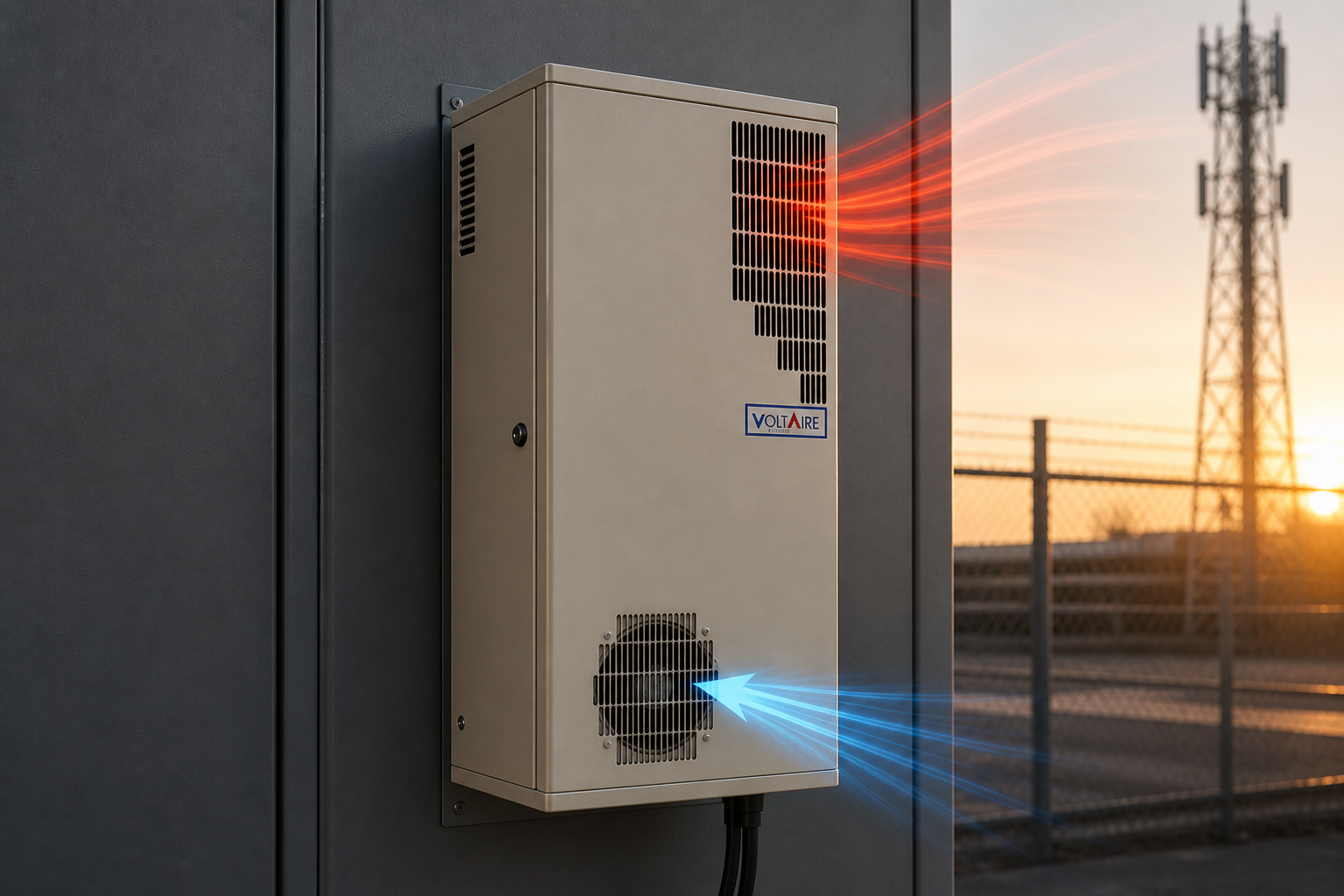
The diagram shows the four airflow points that make a heat exchanger work. Interior (cabinet) air enters the rear of the unit, passes through one side of the aluminum core, and discharges back into the cabinet — never escaping.
Exterior (ambient) air enters from outside, passes through the opposite side of the same core, and exhausts back outside — never entering the cabinet.
The two air streams never touch. Heat transfers through the aluminum core walls. Your sensitive electronics stay sealed in clean, dry, dust-free air while the heat they generate gets dumped to the outside environment.
Sealed Air Paths
Interior and exterior air never mix. Your enclosure stays clean and dry, protected from outdoor contaminants.
No Refrigerant
No compressor, no refrigerant lines, no leak risk. Fewer moving parts means less to maintain and longer service life.
Passive Efficiency
Uses the temperature differential between inside and outside to drive heat transfer. 48VDC models modulate fan speed automatically.
The Key Question
Heat Exchanger or Air Conditioner?
The answer depends on one thing: is your ambient temperature higher or lower than your target internal temperature?
Choose This
Heat Exchanger
- Ambient temperature is below your target internal temperature
- Your enclosure is in a climate-controlled building (factory, data center, server room)
- You need sealed, closed-loop cooling but ambient conditions are mild
- You want lower cost, less maintenance, and no refrigerant
- Your site runs on 48VDC power (telecom, battery plants)
Real Example
A PLC cabinet in a 75°F factory needs to stay below 104°F. The 29°F differential means a heat exchanger easily handles the load with no compressor, no refrigerant, and lower energy cost.
Choose This
Air Conditioner
- Ambient temperature is at or above your target internal temperature
- Your enclosure is outdoors in a hot climate (summer temps above 100°F)
- You need to cool below ambient (heat exchanger physically cannot do this)
- Your heat load is high relative to the ΔT available
- You need precise temperature control with a specific setpoint
Real Example
A telecom shelter in Arizona with 110°F ambient needs to stay below 104°F. Since ambient is hotter than the target, only active refrigeration works. Use a VoltAire AT08.
The Simple Rule
If ambient < target → Heat Exchanger. If ambient ≥ target → Air Conditioner.
Size My Heat Exchanger →Find Your Heat Exchanger in 30 Seconds
Enter your heat load and temperatures — we'll calculate the W/°F required and recommend the right model.
Sum of all components inside the enclosure that generate heat.
Outside the enclosure
Max inside the enclosure
48VDC for telecom/battery sites, AC for industrial/factory power
Inside a building, factory, or sheltered space Exposed to direct sunlight (telecom shelter, OSP cabinet, utility enclosure)
Solar Loading
Direct sunlight on the enclosure adds significant heat — sometimes more than the internal components. Account for this to avoid undersizing.
Top + sun-facing sides
BTU/hr per sq ft
Typical R-3 to R-7
Default: 12 sq ft
Walls passively remove: −W helps cooling
R- insulation blocks: W of wall heat transfer
Enter your heat load and temperatures to see your recommended heat exchanger.
Recommended: Air Conditioner
Ambient (°F) is at or above your target (°F) — heat exchangers can only cool toward ambient. Active refrigeration required.
Your ΔT is only °F. Heat exchangers need at least 10°F differential to work effectively — an air conditioner is the right call here.
Your heat load needs W/°F, but our largest heat exchanger (HTC090B) provides only 90 W/°F. An air conditioner handles the load actively — or you can run two HX units in parallel (call us if that's preferred).
• BTU/hr •
Capacity Check
Exceeds Single-Unit Capacity
Your load needs roughly BTU/hr, which exceeds our largest single AC (AT19 at 19,000 BTU/hr). You may need multiple units or a custom solution.
Call (844) 925-5668Recommended Heat Exchanger
• W/°F •
Capacity Check
Will It Fit?
Mounting & Cutout Dimensions
Heat exchangers mount through a cutout in your enclosure door or wall. Use these dimensions to verify the unit will fit before ordering. All units mount with the condenser side facing outward.
| Model | Unit Size W × H × D | Cutout W × H | Weight |
|---|---|---|---|
| HIX018B | 12.0 × 22.8 × 4.8" | 11.0 × 21.5" | 19.2 lbs |
| HIX025B | 12.0 × 22.8 × 5.3" | 11.0 × 21.5" | 20.1 lbs |
| HIX035B | 17.8 × 35.5 × 5.3" | 16.5 × 34.0" | 40.3 lbs |
| HIX035M | 17.8 × 35.5 × 5.3" | 16.5 × 34.0" | 42.7 lbs |
| HIX035N | 17.8 × 35.5 × 5.3" | 16.5 × 34.0" | 43.0 lbs |
| HIX045B | 17.8 × 35.5 × 6.5" | 16.5 × 34.0" | 45.6 lbs |
| HIX045M | 17.8 × 35.5 × 6.5" | 16.5 × 34.0" | 54.4 lbs |
| HIX045N | 17.8 × 35.5 × 6.5" | 16.5 × 34.0" | 54.7 lbs |
| HIX055B | 17.8 × 35.5 × 8.5" | 16.5 × 34.0" | 47.5 lbs |
| HIX055M | 17.8 × 35.5 × 8.5" | 16.5 × 34.0" | 54.9 lbs |
| HIX055N | 17.8 × 35.5 × 8.5" | 16.5 × 34.0" | 55.5 lbs |
| HTC015B | 12.3 × 20.0 × 7.6" | 9.0 × 20.0" | 22 lbs |
| HTC020B | 12.3 × 20.0 × 7.6" | 9.0 × 20.0" | 22 lbs |
| HTC025B | 12.3 × 20.0 × 7.6" | 9.0 × 20.0" | 22 lbs |
| HTC042B | 16.1 × 24.0 × 11.3" | 16.1 × 24.0" | 45 lbs |
| HTC090B | 19.4 × 46.3 × 11.3" | 19.4 × 46.3" | 86 lbs |
Clearance Needed
Allow 6" minimum clearance in front of the unit for exterior airflow. Internal side needs clear airflow path for the interior fan to circulate cabinet air.
Door or Wall Mount
All HIX and HTC models mount in either a door or side wall. The condenser side must face outdoors / cooler ambient. Mounting hardware included.
Need Exact Specs?
Cutout dimensions above are nominal. Download the installation manual for exact cutout drawings, hole patterns, and mounting hardware specs.
Cutout dimensions shown are approximate. Always reference the official installation manual for your specific model before cutting your enclosure.
Quote Request Sent
We've received your quote request and will respond within one business day with pricing, availability, and lead time.
Need an answer faster? Call (844) 925-5668.
Request a Heat Exchanger Quote
Fill in your specs and we'll send pricing, lead time, and any application notes within one business day.
Two Core Designs
Choose cross flow for standard applications, or counter flow when you need maximum heat transfer in a narrower footprint.
HIX Series
18 – 55 W/°F • 48VDC + 115/230VAC options
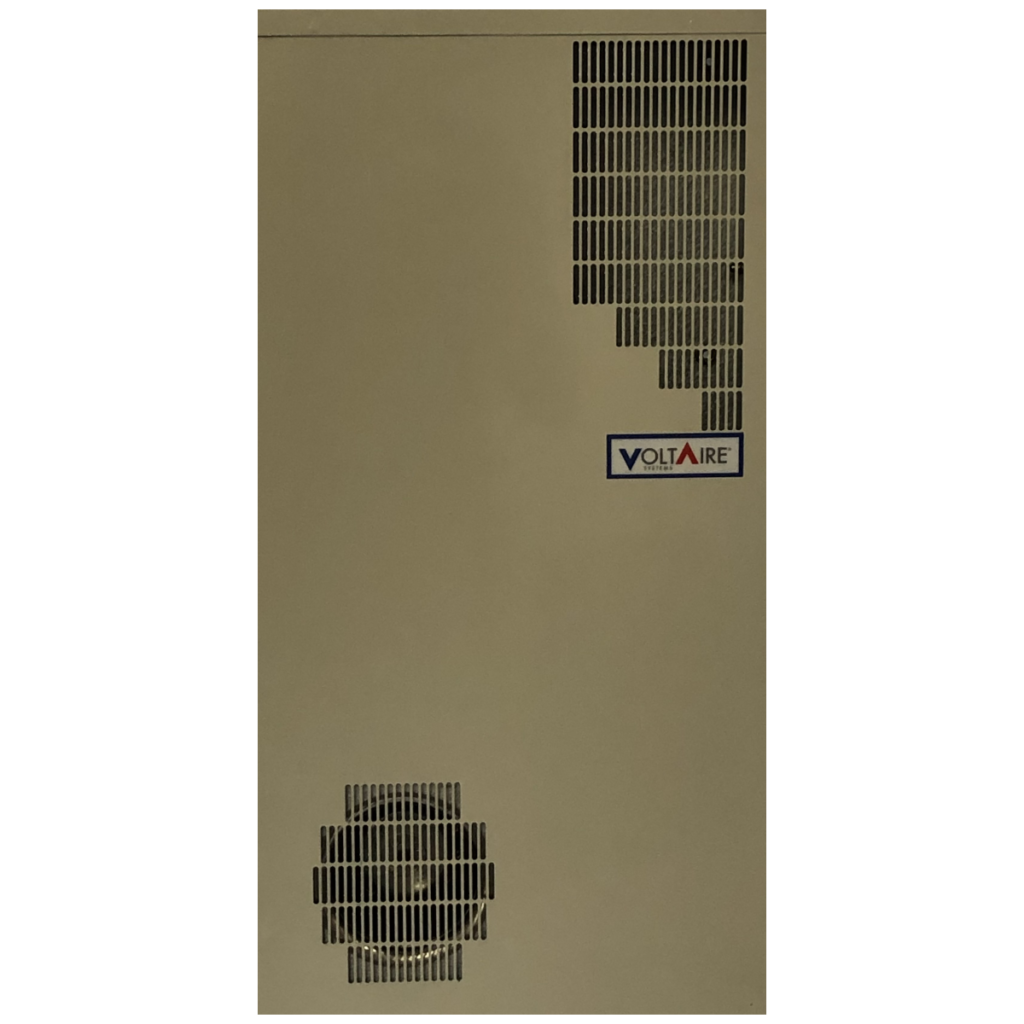
The HIX series uses a cross-flow aluminum core where interior and exterior air streams pass perpendicular to each other. Available in 48VDC with intelligent modulating fan control, and in 115/230VAC for applications that don't require DC power.
| Model | W/°F | Voltage | Weight | dBa | Price |
|---|---|---|---|---|---|
| HIX018B | 18 | 48VDC | 19.2 lbs | 60 |
$1,748
|
| HIX025B | 25 | 48VDC | 20.1 lbs | 61 |
$1,817
|
| HIX035B/ HIX035M/ HIX035N | 35 | 48V / 115V / 230V | 40-43 lbs | 64 |
$2,587
|
| HIX045B/ HIX045M/ HIX045N | 45 | 48V / 115V / 230V | 46-55 lbs | 65 |
$2,611
|
| HIX055B/ HIX055M/ HIX055N | 55 | 48V / 115V / 230V | 48-56 lbs | 68 |
$2,643
|
Prices are the 48VDC builds; 115/230VAC variants are quoted same-day.
Standard Features
HTC Series
15 – 90 W/°F • 48VDC • Narrower Profile
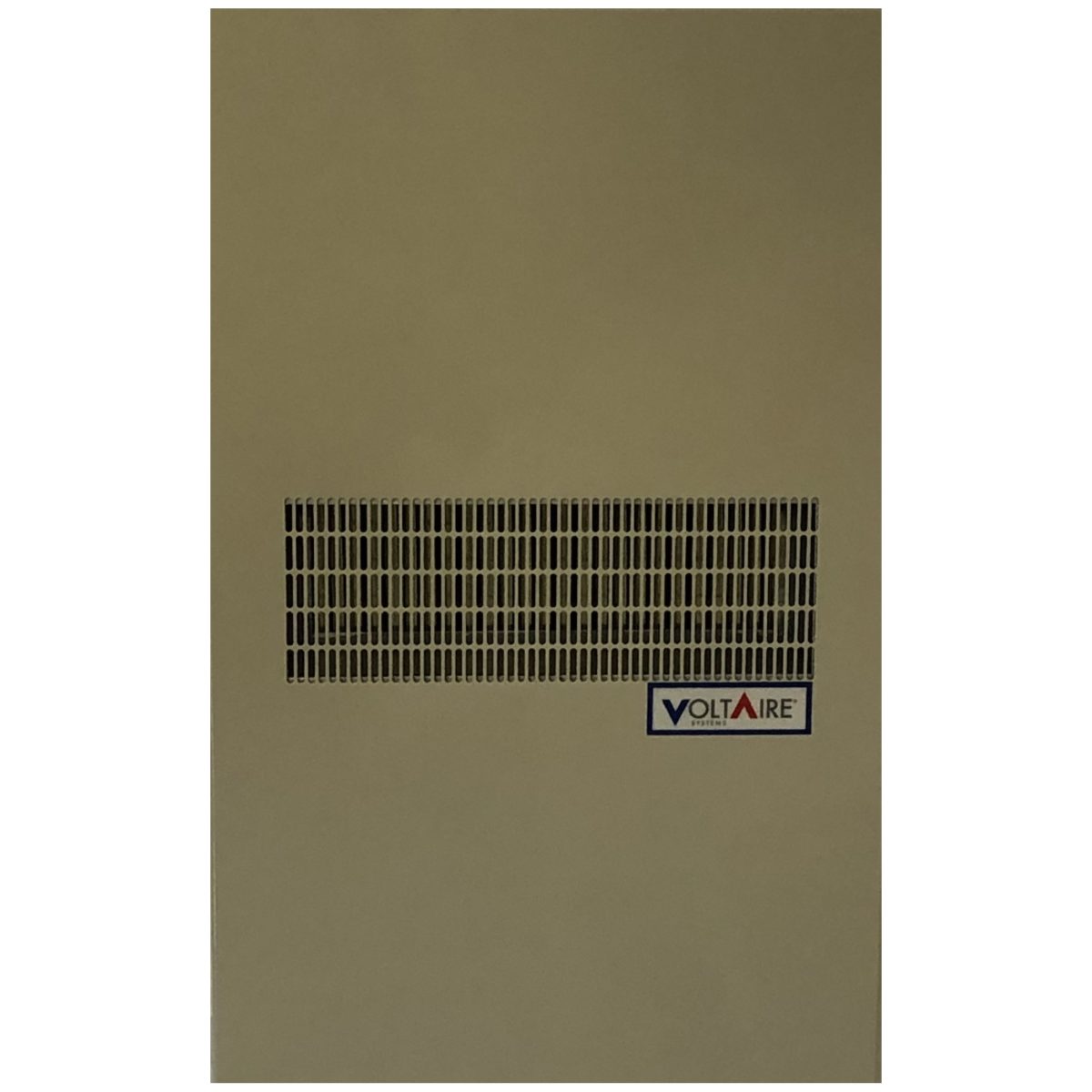
The HTC series uses a tubular counter-flow core where air streams travel in opposite directions through rifled paths — extracting up to 25% more heat from the same core volume compared to cross flow. Narrower width fits tighter cabinet doors, and the axial fan design runs significantly quieter.
| Model | W/°F | BTU @18°F ΔT | Weight | dBa | Price |
|---|---|---|---|---|---|
| HTC042B | 42 | 2,558 | 45 lbs | 66 |
$2,755
|
| HTC090B | 90 | 3,069 | 86 lbs | 68 |
$3,990
|
| HTC015B | 15 | 921 | 22 lbs | 51 | Request Quote |
| HTC020B | 20 | 1,228 | 22 lbs | 56 | Request Quote |
| HTC025B | 25 | 1,535 | 22 lbs | 64 | Request Quote |
Standard Features
Heat Exchangers Cost Far Less to Run
Heat exchangers have no compressor — just fans. That means dramatically lower electricity costs over the life of the unit. Here's the typical difference at three load levels:
Light load (~500W heat)
Heat Exchanger
HTC020B
~25W avg (modulating fans)
$26/year
Air Conditioner
AN02
~320W avg (compressor + fans)
$336/year
Annual Savings
$310
Over 10 years: $3,100
Medium load (~1,500W heat)
Heat Exchanger
HTC042B
~100W avg
$105/year
Air Conditioner
AN04 / AT04
~580W avg
$610/year
Annual Savings
$505
Over 10 years: $5,050
Heavy load (~3,000W heat)
Heat Exchanger
HTC090B
~140W avg
$147/year
Air Conditioner
AT08
~750W avg
$788/year
Annual Savings
$641
Over 10 years: $6,410
Estimates based on 24/7 operation at $0.12/kWh US average. Actual costs vary by duty cycle, climate, and local electricity rate. Heat exchanger fans modulate based on temperature, so real-world consumption is often lower than shown.
See How It Works
Counter Flow Core Explained
The counter flow design routes air streams in opposite directions through rifled tubular paths, extracting up to 25% more heat from the same core volume compared to cross flow.
Intelligent Control
48VDC Modulating Fan Control
All 48VDC models ship with an intelligent fan control board that automatically modulates fan speed based on interior temperature. At low heat loads, the fans run at 25% — saving energy and reducing noise. As temperatures rise, both fans ramp proportionally to 100%.
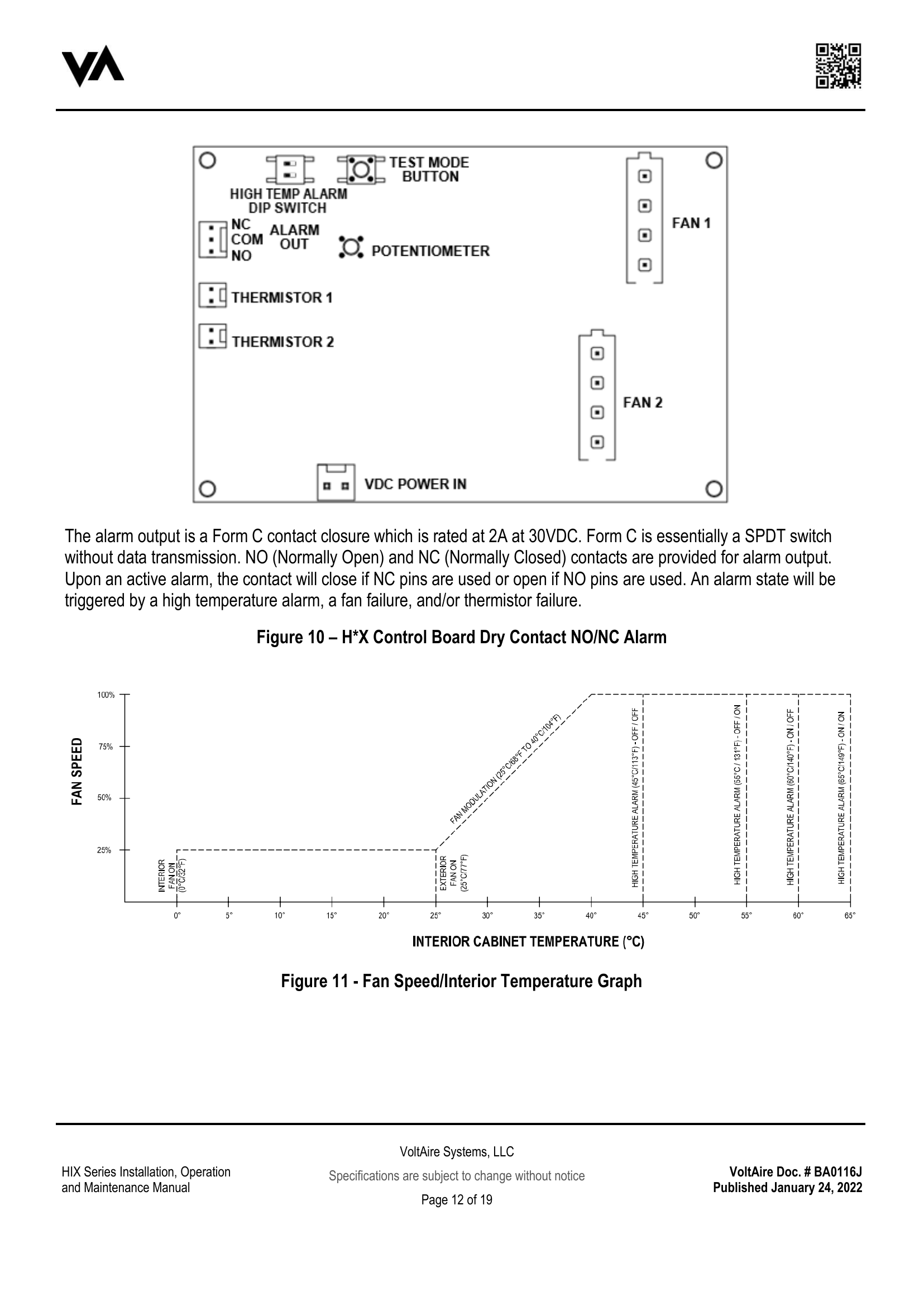
Control board layout and fan speed modulation curve
Below 77°F (25°C)
Interior fan at 25%, exterior fan off
77°F (25°C)
Exterior fan energizes, both modulate
77–104°F (25–40°C)
Both fans ramp 25% to 100%
Above 104°F (40°C)
Both fans at full speed
Alarm System
Form C alarm contact (2A at 30VDC) with both NO and NC terminals. High temp alarm threshold configurable via DIP switch.
Alarm triggers on: high temperature, fan failure, or thermistor failure. 2-minute 30-second test mode available via pushbutton.
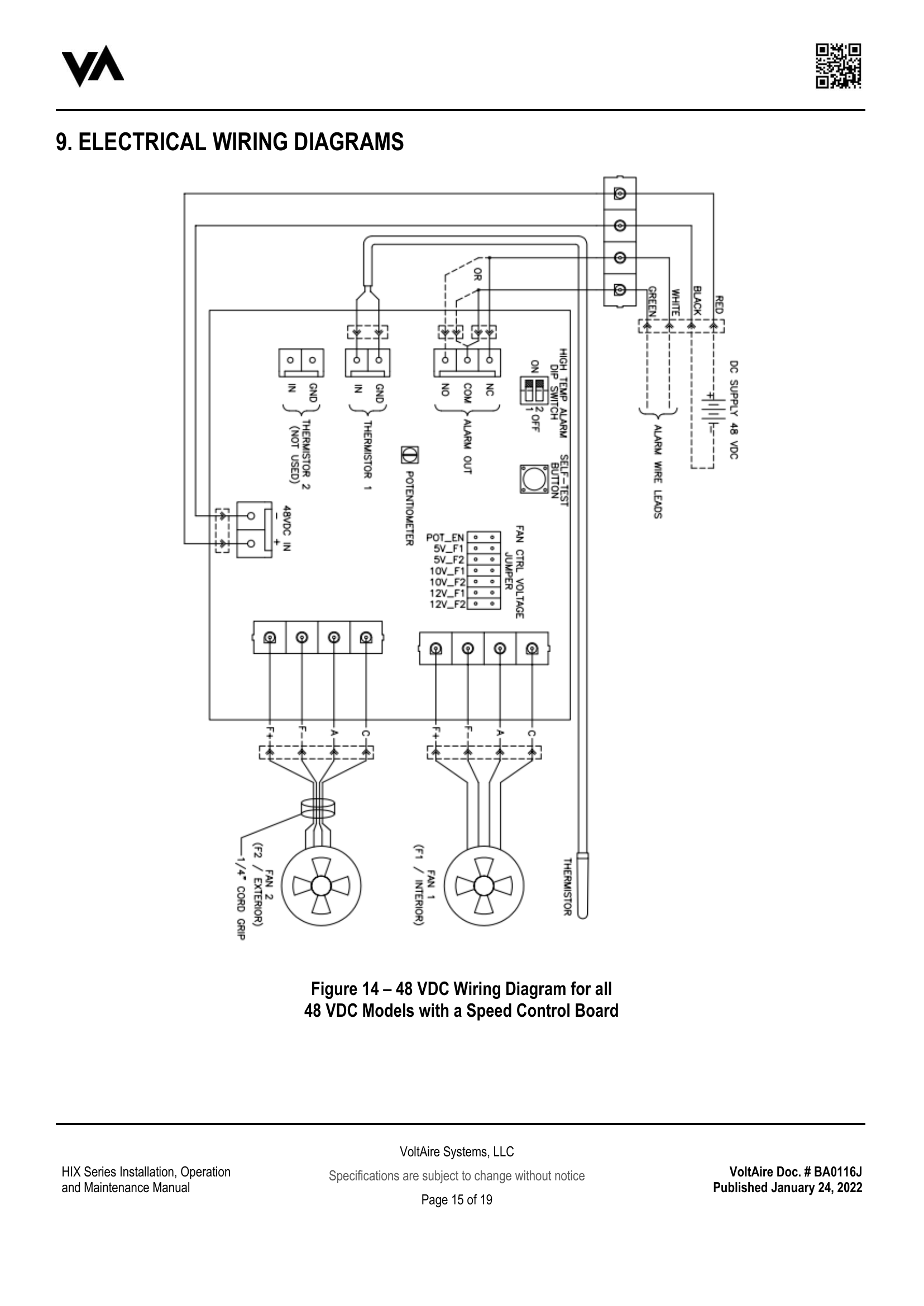
48VDC wiring diagram — full installation manual in Documents
Applications by Industry
Heat exchangers are ideal for enclosures in climate-controlled environments where ambient temperature is below the target internal temperature.
Telecom & Data
Radio base stations, telecom shelters, OSP cabinets, fiber huts, battery & rectifier cabinets
HTC Series (48VDC)
Learn more about telecom & data cooling →Manufacturing
PLC cabinets, CNC machine controls, drive cabinets, automation panels, process control
HIX Series (115/230VAC)
Learn more about manufacturing cooling →Oil & Gas
SCADA enclosures, RTU cabinets, compressor station controls, pipeline monitoring
HIX/HTC (harsh environment)
Learn more about oil & gas cooling →Utilities & Power
Power distribution cabinets, solar inverter enclosures, substation controls
HTC Series (48VDC)
Learn more about utilities & power cooling →Digital Signage
Outdoor kiosks, digital advertisement boards, display system enclosures
HIX Series
Network & Server
Network switching rooms, computer rooms, edge computing cabinets
HTC Series (quietest)
In the Field
Real-World Sizing Examples
Three common scenarios showing how to select the right heat exchanger for your application.
Cell Tower Cabinet
Ambient: 85°F • Target: 122°F
Heat load: 400W
Calculation: 400W / 37°F = 10.8 W/°F
HTC015B (15 W/°F)
Plenty of headroom. 48VDC battery power. Quietest model at just 51 dBa — ideal for residential-adjacent cell sites.
PLC Cabinet in a Factory
Ambient: 75°F • Target: 104°F
Heat load: 800W
Calculation: 800W / 29°F = 27.6 W/°F
HIX035M (35 W/°F, 115VAC)
Climate-controlled factory — no solar load, plenty of ΔT. HIX chosen because the site has 115VAC power, not 48VDC.
Edge Computing Cabinet
Ambient: 72°F • Target: 95°F
Heat load: 1,500W
Calculation: 1,500W / 23°F = 65.2 W/°F
HTC090B (90 W/°F)
High heat load from dense compute hardware but a mild indoor environment. Counter flow handles the load while keeping noise under 68 dBa.
Cross Flow vs. Counter Flow
Not sure which series to choose?
| HIX Cross Flow | HTC Counter Flow | |
|---|---|---|
| Max Capacity | 55 W/°F | 90 W/°F |
| Heat Transfer Efficiency | Standard | Up to 25% better |
| Profile Width | Wider | Narrower |
| Sound Level | 60–68 dBa | 51–68 dBa |
| Voltage Options | 48VDC, 115V, 230V | 48VDC (standard) |
| Best For | Multi-voltage sites | Max cooling, tight spaces |
Model Numbers Explained
How to Read a VoltAire Heat Exchanger Model Number
Every character tells you something about the unit. Here's how to decode HIX035BGA:
Product Series
→ Heat Exchanger
Always "H" — identifies this as a VoltAire heat exchanger product
Product Class
→ Industrial or Telecom
I = HIX (industrial cross flow) • T = HTC (telecom counter flow)
Airflow Configuration
→ Cross Flow or Counter Flow
X = cross flow (perpendicular streams) • C = counter flow (opposite streams, 25% more efficient)
Capacity in W/°F
→ 35 watts per degree Fahrenheit
HIX: 018, 025, 035, 045, 055 • HTC: 015, 020, 025, 042, 090
Electrical Voltage
→ 48VDC
B = 48VDC • M = 115VAC • N = 230VAC
Cabinet Finish
→ RAL 7035 Light Gray
G = Gray • A = Aluminum • S = Stainless Steel • W = Hentzen Off White
Major Revision
→ Initial Release
A = first release. Most current models are revision A.
Custom configurations available — contact us for special paint finishes, voltage options, or modified capacities.
Is a Heat Exchanger Right for You?
A heat exchanger is a great fit if...
A heat exchanger is NOT the right choice if...
Need active cooling instead? VoltAire makes enclosure air conditioners from 800 to 19,000 BTU/hr. View air conditioners →
Complete Specifications
Full model matrix with dimensions, weight, electrical data, and capacity ratings. All models operate from −40°F to 158°F (−40°C to 70°C).
HIX Cross Flow — Full Model Matrix
| Model | W/°F | Voltage | Amps | W × H × D (in) | Weight | dBa |
|---|---|---|---|---|---|---|
| HIX018B | 18 | 48VDC | 1.5 | 12.0 × 22.8 × 4.8 | 19.2 lbs | 60 |
| HIX025B | 25 | 48VDC | 1.5 | 12.0 × 22.8 × 5.3 | 20.1 lbs | 61 |
| HIX035B | 35 | 48VDC | 3.1 | 17.8 × 35.5 × 5.3 | 40.3 lbs | 64 |
| HIX045B | 45 | 48VDC | 3.1 | 17.8 × 35.5 × 6.5 | 45.6 lbs | 65 |
| HIX055B | 55 | 48VDC | 4.3 | 17.8 × 35.5 × 8.5 | 47.5 lbs | 68 |
| HIX035M | 35 | 115VAC | 3.5 | 17.8 × 35.5 × 5.3 | 42.7 lbs | 64 |
| HIX035N | 35 | 230VAC | 1.9 | 17.8 × 35.5 × 5.3 | 43.0 lbs | 64 |
| HIX045M | 45 | 115VAC | 3.5 | 17.8 × 35.5 × 6.5 | 54.4 lbs | 65 |
| HIX045N | 45 | 230VAC | 1.9 | 17.8 × 35.5 × 6.5 | 54.7 lbs | 65 |
| HIX055M | 55 | 115VAC | 3.5 | 17.8 × 35.5 × 8.5 | 54.9 lbs | 68 |
| HIX055N | 55 | 230VAC | 1.9 | 17.8 × 35.5 × 8.5 | 55.5 lbs | 68 |
HTC Counter Flow — Full Model Matrix
| Model | W/°F | BTU @18°F ΔT | Amps | W × H × D (in) | Weight | dBa |
|---|---|---|---|---|---|---|
| HTC042B | 42 | 2,558 | 3.4 | 16.1 × 24.0 × 11.3 | 45 lbs | 66 |
| HTC090B | 90 | 3,069 | 4.8 | 19.4 × 46.3 × 11.3 | 86 lbs | 68 |
| HTC015B | 15 | 921 | 0.5 | 12.3 × 20.0 × 7.6 | 22 lbs | 51 |
| HTC020B | 20 | 1,228 | 0.8 | 12.3 × 20.0 × 7.6 | 22 lbs | 56 |
| HTC025B | 25 | 1,535 | 1.7 | 12.3 × 20.0 × 7.6 | 22 lbs | 64 |
Capacity is nominal at Δ18°F (Δ10°C) based on free airflow. Exterior 113°F (45°C), interior 131°F (55°C). All HTC models are 48VDC with modulating fan control.
Frequently Asked Questions
What is the difference between a heat exchanger and an enclosure air conditioner?
Can a heat exchanger cool below ambient temperature?
What does W/°F mean for heat exchangers?
Do VoltAire heat exchangers require maintenance?
Which is better: cross flow (HIX) or counter flow (HTC)?
Need More Detailed Sizing?
Use our full sizing calculator to add multiple components, calculate solar loading, and compare both heat exchangers and air conditioners.
Spec Sheets & Manuals
Documents & Downloads
Full product data sheets and installation manuals. Cut sheets cover specs, applications, and approvals. IOM manuals cover installation, wiring, and maintenance.
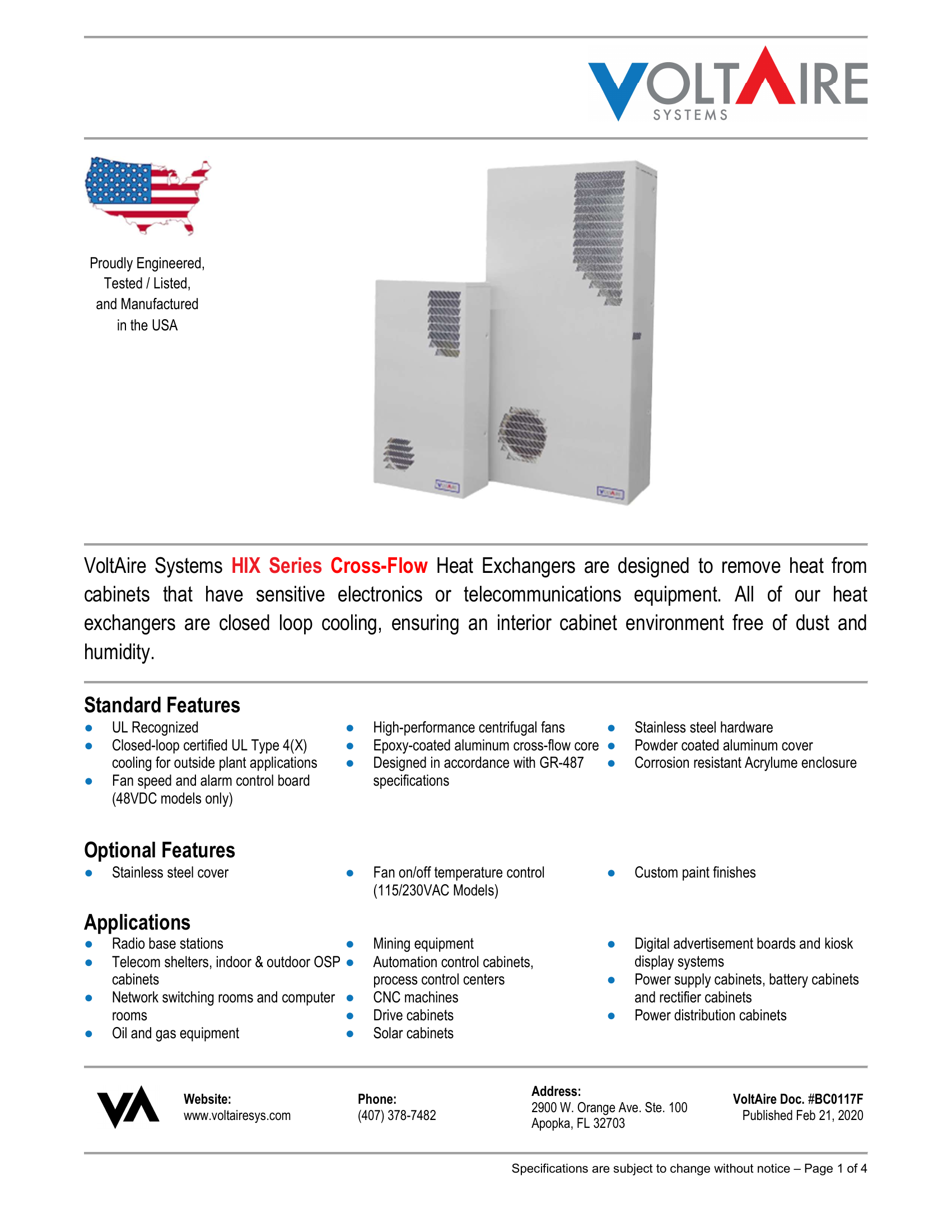
HIX Cross Flow Spec Sheet
Complete data sheet covering all HIX Series heat exchangers — performance, dimensions, electrical specs, and applications.
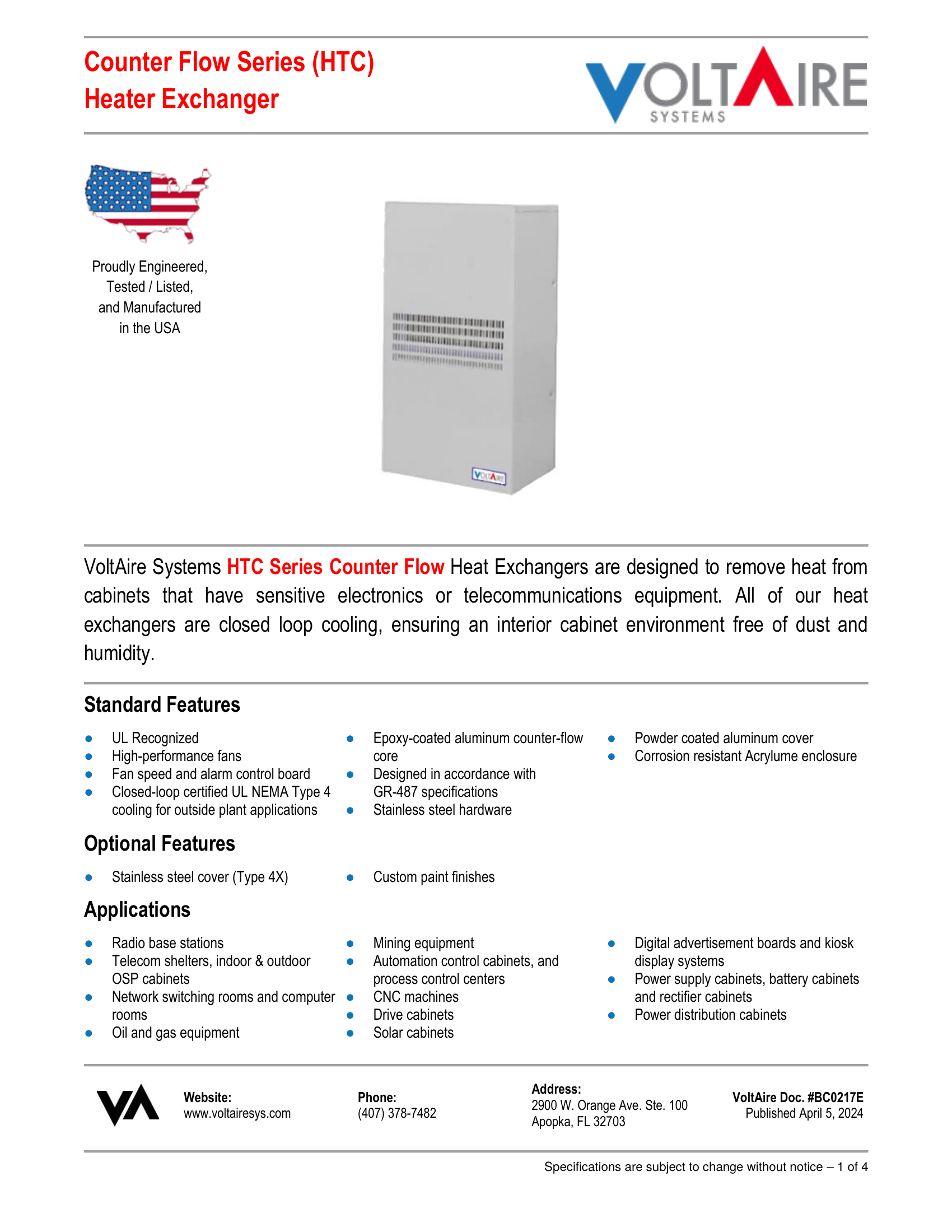
HTC Counter Flow Spec Sheet
Complete data sheet covering all HTC Series heat exchangers — performance, dimensions, electrical specs, and applications.
Need Help Sizing a Heat Exchanger?
Heat exchanger selection depends on your enclosure's heat load, ambient conditions, and maximum allowable interior temperature. Contact us with your application details and we'll recommend the right unit.