
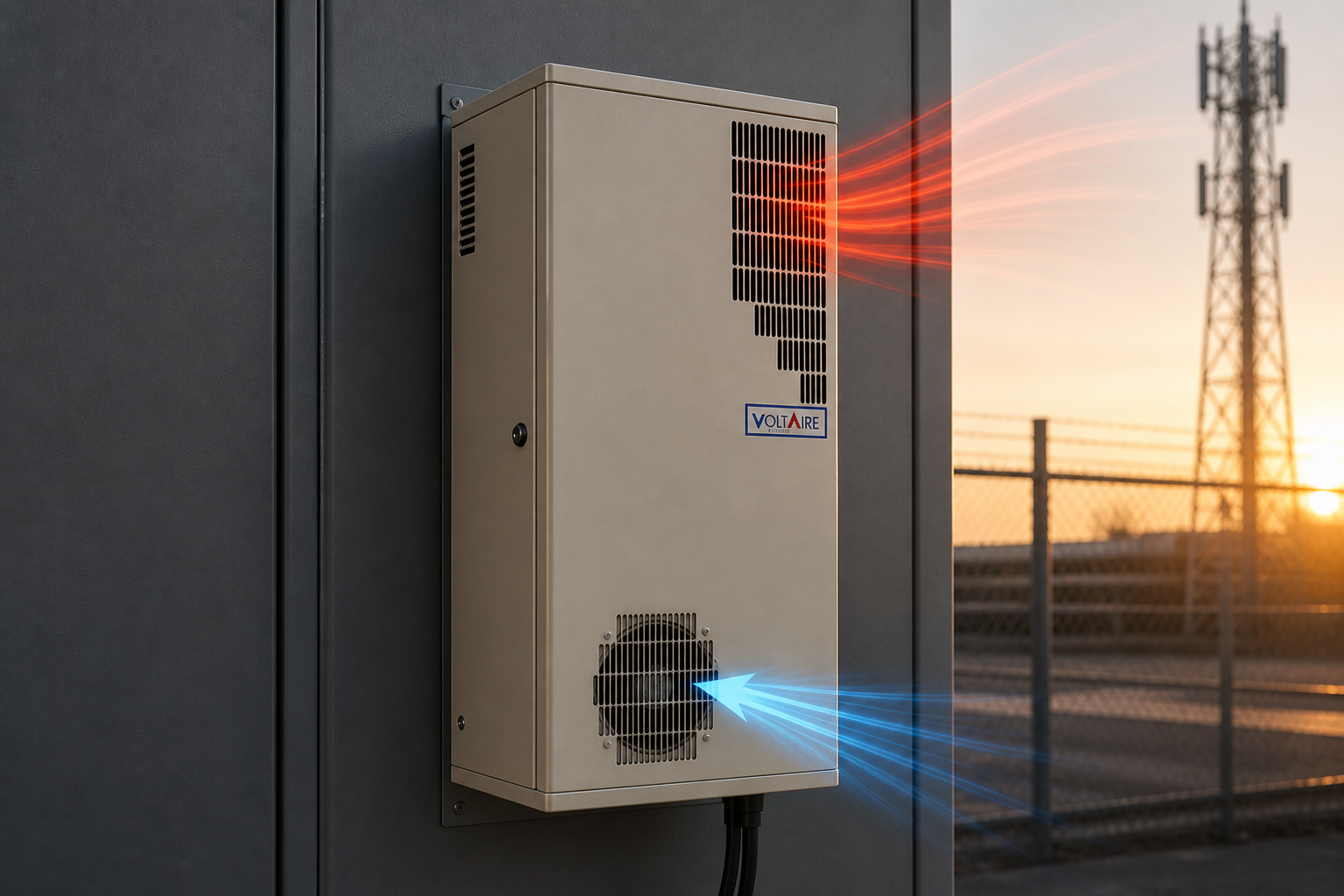
Built for −48V Plant Sites
True 48VDC Enclosure Cooling for DC Plant Sites
Direct connection to −48V plant. No inverter, no efficiency loss, no extra failure point. Air conditioners and air-to-air heat exchangers for telecom, broadband, edge compute, oil & gas SCADA, and any outdoor cabinet running on DC plant power.
Quick Summary
Any outdoor cabinet or shelter running on −48VDC plant power can use VoltAire 48VDC cooling. The lineup: 5 HIX cross-flow heat exchangers (HIX018B–HIX055B, 18–55 W/°F ), 5 HTC counter-flow heat exchangers (HTC015B–HTC090B, 15–90 W/°F — the entire HTC line is 48VDC-only), and 3 AT-series outdoor air conditioners (AT04, AT06, AT12 — 4,000 to 12,000 BTU/hr). All connect directly to −48V plant power. No inverter, no efficiency loss, no extra point of failure. Used by telecom operators, broadband ISPs, edge data center builders, oil & gas SCADA integrators, utility engineers, and federal field-site contractors. Every unit is NEMA 4/4X rated , GR-487 compliant , BABA eligible , and manufactured in Orlando, FL.
Why 48VDC Matters
Four reasons engineers specify true 48VDC cooling
The −48V plant power standard has been in continuous use across telecom and broadband infrastructure for over a century — battery-backed DC distribution survives utility outages by design. Any site already running on a DC plant gets four real benefits from cooling that matches the plant instead of requiring an inverter.
No inverter losses
Telecom-grade inverters are 92–96% efficient. A 200W cooling unit pulls 208–217W when fed through an inverter. True 48VDC eliminates that loss for the full service life of the site.
One less failure point
An inverter is a serial component with its own MTBF, thermal load, and surge vulnerability. Removing it from the cooling chain measurably improves end-to-end uptime — the metric that actually matters at an unstaffed site.
Battery-resilient cooling
When utility power fails, the equipment runs on battery — but the cooling unit does too. With 48VDC cooling, the entire site (compute + radio + cooling) shares the same battery runway. No partial outage where the gear is alive but overheating.
Compliance trifecta out of the box
All VoltAire 48VDC products carry GR-487 , NEMA 4/4X , and UL 484/UL 1995 listings, plus BABA domestic-content compliance — the full spec stack for federal broadband programs (BEAD, RDOF, ReConnect, MMG) and federal field deployments.
Who Specifies 48VDC Cooling
Six markets that buy 48VDC enclosure cooling
Telecom built the −48V plant standard, but anywhere battery-backed DC infrastructure powers outdoor cabinets, the same logic applies: cooling that matches the plant survives the same outage events the rest of the site is engineered for.
Telecom & Wireless
Cellular base stations, 5G macro and small-cell cabinets, microwave backhaul, central office annexes. The original −48V plant — every site already has DC infrastructure and every operator already specifies GR-487. VoltAire HIX/HTC heat exchangers and AT-series ACs drop directly into existing telecom plant builds.
Outdoor telecom guide →Wireline, Broadband & Federal Programs
Fiber huts, OSP cabinets, DOCSIS distribution, FTTH equipment shelters. Federally funded broadband programs (BEAD, RDOF, ReConnect, MMG) require both DC plant compatibility and BABA domestic content — VoltAire is one of a small number of cooling vendors that meets both without exception requests.
BABA compliance guide →Edge Compute & Micro Data Centers
Modular and prefab data centers, edge compute cabinets, IoT gateway shelters, Open Compute Project deployments. OCP standardized 48V rack power years ago, and edge sites at cell towers and remote facilities increasingly run −48V plant for resilience. HTC counter-flow handles the heat density of edge compute particularly well.
Heat exchanger product page →Oil & Gas SCADA
Pipeline RTUs, wellhead SCADA, compressor station controls, midstream metering, gathering-system telemetry. Battery + solar + remote = −48VDC plant. Outdoor cabinets need NEMA 4X corrosion protection (sour gas, H&sub2;S) plus DC plant compatibility — typically passive HIX in moderate climates and AT-series ACs for hotter, dirtier ambients.
Outdoor industrial guide →Utility & Energy
Substation battery rooms (typically −48V or −125V protection plants), solar inverter buildings, microgrid controllers, battery energy storage system (BESS) auxiliary panels. DC infrastructure that needs cooling that survives the same outage events the rest of the plant is engineered for.
Defense & Federal Field Sites
Transportable communications shelters, ISR cabinets, FAA/NOAA radar bungalows, emergency communications, federal field operations. Battery-backed for tactical or contingency reasons. The combination of BABA domestic content + true 48VDC + NEMA 4X is the typical federal field-site specification.
BABA compliance guide →48VDC Heat Exchanger Lineup
10 heat exchanger models — all 48VDC
The full HTC counter-flow line is 48VDC-only by design (modulating EC fans). The HIX cross-flow line offers 48VDC variants alongside 115VAC and 230VAC. Use the W/°F rating to match your heat load against the available ambient differential.
| Model | Series | Capacity | Price | Common Use |
|---|---|---|---|---|
| HTC015B | HTC Counter Flow | 15 W/°F | Request Quote | Smallest counter-flow. Quietest unit in the lineup. |
| HTC020B | HTC Counter Flow | 20 W/°F | Request Quote | Compact. 25% more efficient than equivalent cross-flow. |
| HTC025B | HTC Counter Flow | 25 W/°F | Request Quote | Mid-capacity counter-flow. |
| HTC042B | HTC Counter Flow | 42 W/°F |
$2,755
|
High-capacity counter-flow for dense cabinets. |
| HTC090B | HTC Counter Flow | 90 W/°F |
$3,990
|
Largest unit. For high-heat-load equipment shelters. |
| HIX018B | HIX Cross Flow | 18 W/°F |
$1,748
|
Small cabinets — fiber distribution, small-cell, RTU panels. |
| HIX025B | HIX Cross Flow | 25 W/°F |
$1,817
|
Compact cross-flow. |
| HIX035B | HIX Cross Flow | 35 W/°F |
$2,587
|
Mid-capacity cross-flow — common 5G and edge-compute spec. |
| HIX045B | HIX Cross Flow | 45 W/°F |
$2,611
|
Higher-capacity cross-flow. |
| HIX055B | HIX Cross Flow | 55 W/°F |
$2,643
|
Largest cross-flow. |
48VDC Air Conditioner Lineup
3 AT-series outdoor ACs — all 48VDC
For sites where ambient runs hotter than your equipment max temperature, an air conditioner is the right answer. AT04, AT06, and AT12 are available in true 48VDC for direct DC plant integration. NEMA 4/4X, GR-487 compliant, full −40°F to 131°F (−40°C to 55°C) operating range.
AT04 (RBW07/RBS07)
4,000 BTU/hr
Compact NEMA 4/4X — fiber distribution, RTU panels, small telco cabinets, oil & gas wellhead enclosures.
Configure & Price Air ConditionerAT06 (RBW07/RBS07)
6,000 BTU/hr
Mid-capacity NEMA 4/4X — typical 5G small-cell, edge-compute cabinets, midstream SCADA.
Configure & Price Air ConditionerAT12 (RBW07/RBS07)
12,000 BTU/hr
Larger NEMA 4/4X — fiber huts, equipment shelters, micro data centers, compressor station controls.
Configure & PriceDecision Guide
When to specify 48VDC vs. AC-input cooling
Not every site needs 48VDC. Here's a clean rule of thumb that captures 95% of decisions, regardless of vertical.
Site Profile
DC-plant-only or DC-primary site
Cell sites, fiber huts, BEAD broadband enclosures, edge compute cabinets, pipeline RTUs, substation control panels, federal field deployments
Specify
True 48VDC (HIX*B, HTC*, AT04/06/12 RBW07)
Direct plant connection, no inverter. The cooling unit shares the site's battery runway, eliminates inverter as a failure point, and matches the environmental rigor outdoor DC sites already require.
Site Profile
Reliable utility AC with full UPS coverage
Indoor central offices, urban POPs, colocation rooms, plant-floor industrial panels with utility power
Specify
115VAC or 230VAC variants
AC-input variants are simpler to wire and don't require coordination with the DC plant breaker layout. Use HIX*M (115V), HIX*N (230V), or AT-series RPW/RNW SKUs.
Site Profile
Hybrid: utility AC primary, DC plant for backup
Carrier hotels, large central offices, edge data centers with diesel + DC backup
Specify
Mix: AC-input ACs + 48VDC heat exchangers
Run high-demand ACs from utility (lower wire gauge, simpler install). Run smaller passive heat exchangers from the DC plant so basic cooling survives utility outage. Talk to engineering for redundant-cooling specs.
Compliance & Certifications
Standards every 48VDC variant meets
The same compliance scope across the full 48VDC product line, regardless of vertical. The combination matters: many cooling vendors meet some of these, fewer meet all of them in one product.
GR-487 (Telcordia)
Outdoor electronic equipment standard. 720-hour salt fog (ASTM B117), thermal cycling, surge withstand. Required by most ILECs, broadband carriers, and increasingly specified for federal field deployments.
NEMA 4 / 4X
Sealed against wind-driven rain, dust, ice, corrosion. NEMA 4X adds salt and chemical resistance for coastal, industrial, and oil & gas sites.
UL 484 / UL 1995
UL 484 for AC units (AT-series), UL 1995 for heat exchangers (HIX/HTC). Required for safety listing and most municipal permits.
BABA / Made in USA
Build America, Buy America. Manufactured in Orlando, FL — meets domestic-content threshold for federally funded broadband programs (BEAD, RDOF, ReConnect, MMG) and federal field-site procurement.
Real Scenarios
Three real 48VDC site specs across three verticals
Worked examples — heat load, ambient, target — and the resulting product recommendation.
Scenario
5G small-cell cabinet, Phoenix metro
- Ambient
- Max 118°F summer (with solar load)
- Heat Load
- 850W (radio + compute + battery)
- Target
- 104°F max interior
Recommendation
AT06 RBW07 6,000 BTU 48VDC outdoor AC. Heat exchanger not viable (ambient exceeds target). 48VDC keeps the cooling on the same battery runway as the radio — when utility drops, both ride the battery to the same depletion point.
Scenario
Pipeline RTU cabinet, West Texas
- Ambient
- −10°F winter to 110°F summer
- Heat Load
- 180W (RTU + cell modem + battery)
- Target
- 104°F max interior
Recommendation
HIX018B 18 W/°F cross-flow heat exchanger. Equipment can tolerate ~110°F max interior, so passive cooling works. 48VDC direct from the existing battery + solar plant. No compressor, no refrigerant, no inverter — three failure modes eliminated for a site visited once per quarter.
Scenario
BEAD-funded fiber distribution hut, rural Kentucky
- Ambient
- Max 95°F summer, −15°F winter
- Heat Load
- 2,400W (multi-carrier transport + DC plant + battery)
- Target
- 95°F max interior
Recommendation
HTC042B 42 W/°F counter-flow heat exchanger. 25% more efficient than equivalent cross-flow at this capacity. 48VDC + GR-487 + BABA all native — qualifies for BEAD federal funding without exception requests, which is the part that derails most cooling specs at the integrator review.
Frequently Asked Questions
Common 48VDC cooling questions from telecom, broadband, edge data center, and industrial DC plant integrators.
Is 48VDC really more reliable than running a 115V/230V unit through an inverter?
Do data centers really use 48VDC, or is that just a telecom thing?
What about substation battery rooms or solar inverter buildings?
Can I run a VoltAire 48VDC unit from a UPS or rectifier-only setup?
What gauge wire and breaker should I use for a 48VDC cooling unit?
Are there 24VDC variants?
Why is the entire HTC counter-flow line 48VDC only?
How does 48VDC affect BABA / Made in USA compliance?
What's the operating temperature range for 48VDC variants?
Can I install a 48VDC unit and an AC unit on the same site for redundancy?
Related
Go deeper
Outdoor Telecom Cabinet Cooling →
Application guide for cell sites, 5G cabinets, and remote telco huts.
Outdoor Industrial Enclosure Cooling →
Pipeline RTUs, oil & gas SCADA, mining, water/wastewater controls.
Air-to-Air Heat Exchangers →
Full HIX cross-flow and HTC counter-flow product details and spec sheets.
GR-487 Compliance Guide →
720-hour salt fog, thermal cycling, what GR-487 covers and what it doesn't.
BABA Compliance for Telecom →
Domestic-content rules for federally funded broadband and telecom builds.
How to Size Enclosure Cooling →
Sizing math: heat load, ambient, target, and the safety factor.
Specifying a 48VDC build?
Whether it's a cell site, a BEAD fiber hut, an edge compute cabinet, a pipeline RTU, or a federal field shelter — get model recommendations matched to your DC plant, climate zone, and compliance requirements. VoltAire ships from Orlando, FL with US-stocked replacement parts.