
Complete Technical Guide
The Complete Guide to Enclosure Air Conditioning
How to size, select, install, and maintain closed-loop cooling for industrial electrical enclosures. Written by VoltAire’s engineering team for facilities managers, controls engineers, and panel shops.
What Is Enclosure Air Conditioning?
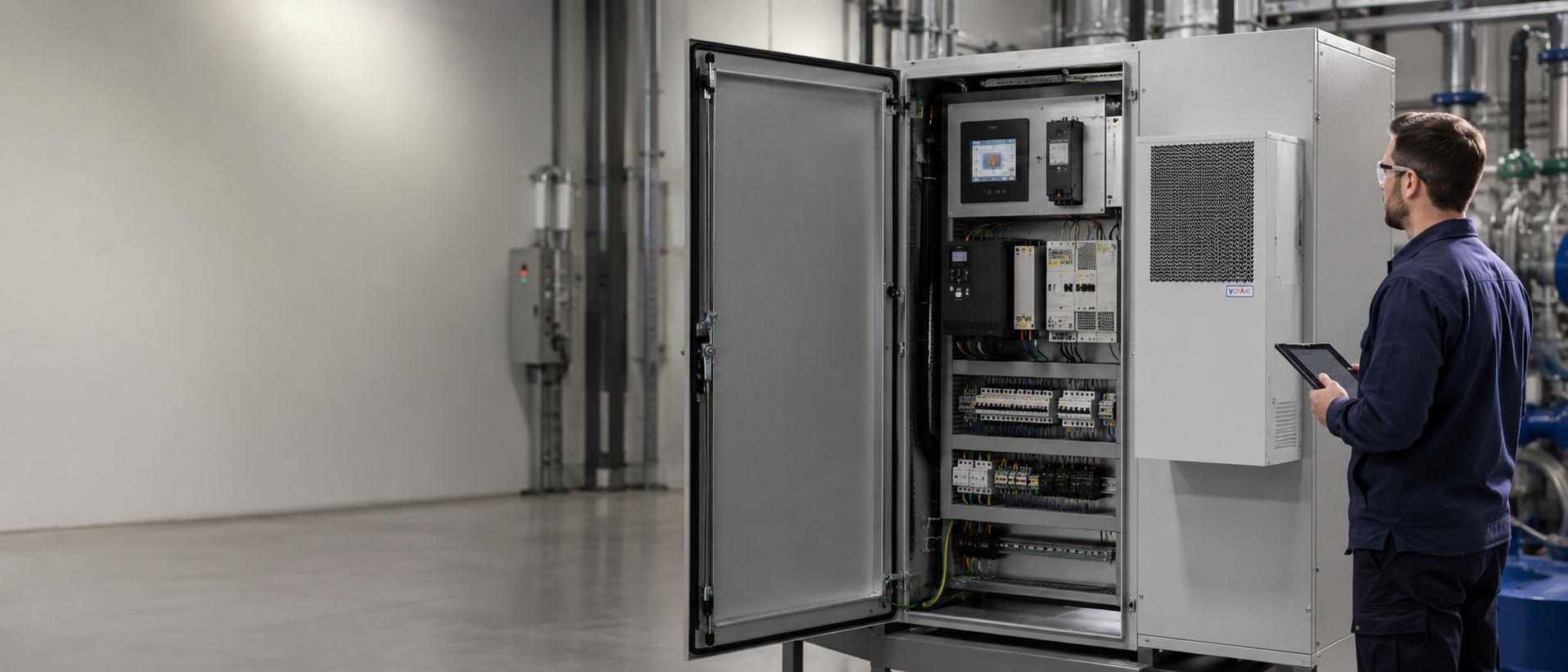
Enclosure air conditioning is the practice of using active, refrigerant -based cooling systems to control the internal temperature of sealed electrical enclosures , cabinets, and shelters. Unlike comfort air conditioning designed for occupied spaces, enclosure air conditioners are purpose-built to protect sensitive electronic components, variable frequency drives , programmable logic controllers, power supplies, and communication equipment from thermal damage. These compact, self-contained units mount directly onto the enclosure wall or door, maintaining a sealed environment while rejecting heat to the outside air.
Every piece of electrical equipment generates waste heat during operation. A single variable frequency drive can dissipate 200 to 500 watts of heat into the surrounding air. A power supply running at 90% efficiency converts the remaining 10% of its input power directly into heat. In a typical industrial control panel containing multiple drives, a PLC, an HMI, several power supplies, and various relays and contactors , the total internal heat load can easily reach 1,000 to 5,000 watts. Without active cooling, that heat accumulates inside the sealed enclosure, raising the internal temperature until components begin to derate, malfunction, or fail permanently.
Why Sealed Enclosures Need Active Cooling
Industrial enclosures are sealed for good reason. NEMA 4 , 4X , and 12 ratings protect internal components from dust, moisture, oil mist, corrosive chemicals, and washdown spray. Opening the enclosure to outside air with ventilation fans or louvers defeats the purpose of the NEMA rating entirely. Dust-laden air fouls circuit boards and connector pins. Humid air causes condensation on cold surfaces, leading to short circuits and corrosion. Chemical fumes attack copper traces and solder joints. A sealed enclosure eliminates these risks, but it also traps heat inside.
The fundamental heat equation for any enclosure is straightforward: total heat gain equals internal heat dissipation plus ambient heat transfer plus solar gain . Internal heat dissipation is the sum of all component waste heat. Ambient heat transfer is the heat conducted through the enclosure walls when the outside temperature exceeds the inside temperature. Solar gain applies only to outdoor enclosures and can add 500 to 1,500 BTU/hr depending on the enclosure surface area, color, and geographic location. When total heat gain exceeds the enclosure’s ability to passively dissipate heat through its walls, active closed-loop cooling is required.
When Passive Ventilation Is Not Enough
Passive cooling through natural convection works only when the ambient temperature is significantly lower than the target internal temperature and the heat load is minimal. For enclosures in air-conditioned server rooms generating under 100 watts of heat, natural convection through the cabinet walls may suffice. But the moment the enclosure is installed in a factory floor environment at 95°F, a rooftop telecom shelter in Arizona at 120°F, or an outdoor oil and gas platform in the Gulf Coast humidity, passive cooling fails. Any application where the ambient temperature approaches or exceeds the maximum rated temperature of the internal components (typically 104°F to 122°F for most industrial electronics) requires active, closed-loop cooling.
Core Concepts in Enclosure Cooling
Ten foundational principles every controls engineer and facilities manager should understand before specifying an enclosure air conditioner.
1. Closed-Loop vs. Open-Loop Cooling
Cooling systems for electrical enclosures fall into two fundamental categories: closed-loop and open-loop . The distinction determines whether outside air ever contacts the components inside the enclosure. In an open-loop system, such as a filtered fan or ventilation blower, ambient air is drawn directly into the enclosure through intake filters and exhausted through outlet grilles. This approach is simple and inexpensive but introduces dust, moisture, and contaminants into the cabinet, compromising the NEMA seal.
A closed-loop system maintains complete separation between the internal enclosure air and the external ambient air. Enclosure air conditioners and air-to-air heat exchangers are both closed-loop devices. The internal air circulates through the evaporator coil (or through one side of a heat exchanger), while a separate external air circuit handles heat rejection to the surrounding environment. The two airstreams never mix. This design preserves the enclosure’s NEMA 4, 4X, or 12 rating and is the only acceptable approach for applications in dirty, humid, corrosive, or hazardous environments.
2. BTU Ratings and Heat Load Calculation
The cooling capacity of an enclosure air conditioner is rated in BTU per hour (BTU/hr) . One BTU is the amount of energy required to raise the temperature of one pound of water by one degree Fahrenheit. Since electrical components generate heat measured in watts , you need a conversion factor: 1 watt = 3.412 BTU/hr. This is a fixed physical constant and the most important number in enclosure cooling specification.
To determine the required BTU/hr rating for your air conditioner, multiply the total internal heat load in watts by 3.412. A control panel generating 1,500 watts of internal heat requires at least 5,118 BTU/hr of cooling capacity just to handle the internal load. Add ambient heat transfer and solar gain to get the total requirement. Industry best practice is to add a 10-20% safety margin above the calculated total to account for future component additions, aging, and extreme ambient conditions. A unit sized exactly at the calculated load will run continuously at full capacity with no margin for error.
3. NEMA Ratings: 3R, 4, 4X, and 12
NEMA enclosure ratings define the level of environmental protection a cabinet provides against specific hazards. The air conditioner must match or exceed the enclosure’s NEMA rating to maintain the overall protection level. NEMA 12 enclosures are designed for indoor use and protect against dust, dripping water, and oil seepage. NEMA 3R enclosures are suitable for outdoor use and protect against falling rain and external ice formation, but they are not dust-tight or suitable for washdown.
NEMA 4 enclosures provide protection against windblown dust and rain, splashing water, hose-directed water, and external ice formation. They are the standard for outdoor industrial installations. NEMA 4X adds corrosion resistance to the NEMA 4 specification, typically achieved through 304 or 316 stainless steel construction. NEMA 4X is required for coastal environments, food and beverage processing (washdown with caustic cleaners), chemical plants, and any application where the enclosure is exposed to corrosive chemicals or salt spray. All VoltAire enclosure air conditioners are rated NEMA 4/4X as standard, with stainless steel hardware and gasket-sealed construction.
NEMA 12
Indoor, dust/drip
NEMA 3R
Outdoor, rain/ice
NEMA 4
Outdoor, washdown
NEMA 4X
+ Corrosion resist
4. Refrigerant: R-134A
R-134A (1,1,1,2-tetrafluoroethane) is the industry-standard refrigerant for enclosure air conditioners. It is a hydrofluorocarbon (HFC) with zero ozone depletion potential, making it compliant with the Montreal Protocol. R-134A operates efficiently across the temperature ranges encountered in industrial enclosure cooling, with evaporator temperatures typically between 35°F and 50°F and condenser temperatures between 100°F and 150°F depending on ambient conditions.
All VoltAire units ship factory-charged with R-134A in a hermetically sealed refrigerant circuit. Under normal operating conditions, the system never requires field charging or refrigerant addition. The hermetic compressor, brazed copper tubing, and factory-tested joints ensure a leak-free system throughout its service life. If refrigerant loss occurs due to vibration damage or physical impact, the system should be repaired by a certified HVAC technician and recharged to the factory specification on the unit nameplate.
5. Voltage Options: 115V, 230V, 460V, and 48VDC
Enclosure air conditioners are available in multiple voltage configurations to match the power supply available at the installation site. The four standard options cover virtually every industrial and telecom application worldwide.
115VAC
Single-phase. Standard North American receptacle power. Most common for small to mid-size units. Convenient where a 120V branch circuit is available inside or adjacent to the panel.
230VAC
Single-phase. Standard for larger units and international installations. Common in industrial panels where 208V or 240V is available from the facility power distribution.
460VAC
Three-phase. Used in heavy industrial environments where only high-voltage power is available. Common in motor control centers, substations, and large drive lineups.
48VDC
Direct current. Designed for telecom shelters, battery plants, and DC-powered applications. GR-487 compliant. Operates directly from the -48VDC bus without inverters.
6. Thermoelectric vs. Compressor-Based Cooling
Thermoelectric coolers (TECs, also called Peltier coolers) use the Peltier effect to transfer heat across a semiconductor junction when DC voltage is applied. They have no moving parts other than fans, no refrigerant, and no compressor. This makes them silent, vibration-free, and maintenance-free. However, their cooling capacity is severely limited, typically maxing out at 200 to 400 BTU/hr. Their efficiency (COP) is roughly 0.3 to 0.5, meaning they consume more energy than they move in heat.
Compressor-based enclosure air conditioners use the same vapor-compression refrigeration cycle as residential and commercial HVAC systems, scaled down and hardened for industrial environments. A hermetic compressor circulates R-134A refrigerant through an evaporator (cold side, inside the enclosure) and a condenser (hot side, outside the enclosure). Compressor-based systems deliver cooling capacities from 1,000 to 19,000 BTU/hr with COP values of 1.5 to 2.5, making them far more energy efficient than thermoelectric alternatives. For any heat load above approximately 400 BTU/hr, compressor-based cooling is the only practical choice.
7. Air-to-Air Heat Exchangers vs. Active Cooling
An air-to-air heat exchanger transfers heat from the inside of the enclosure to the outside environment without using a refrigeration cycle. Heat exchangers use either a plate-type or tube-type design with two separate fan circuits. Internal enclosure air passes over one side of the heat transfer surface, while external ambient air passes over the other side. Heat flows naturally from the warmer internal air to the cooler external air.
The critical limitation is that a heat exchanger can only cool the enclosure to a few degrees above the ambient temperature. If the ambient air is 95°F, the best a heat exchanger can achieve inside the cabinet is approximately 100°F to 105°F. This makes heat exchangers ideal for applications where ambient temperature is well below the component rated temperature and the primary goal is to move internally generated heat out of the sealed enclosure. They are simpler, less expensive, and require less maintenance than compressor-based units. VoltAire offers the HIX and HTC series for these applications.
8. Ambient Temperature Considerations
The ambient temperature at the installation site directly affects both the cooling capacity of the air conditioner and the total heat load on the enclosure. Most enclosure air conditioner specifications list a capacity rating at a specific set of test conditions, typically 95°F ambient and 95°F internal setpoint. As ambient temperature increases above the rated condition, the unit’s effective cooling capacity decreases because the condenser must work harder to reject heat into hotter outside air.
VoltAire units are rated for operation across an extreme ambient range of -40°F to 131°F (-40°C to 55°C). The low-ambient kit includes a crankcase heater to prevent refrigerant migration during cold starts and a condenser fan speed controller to maintain adequate head pressure in low temperatures. For installations in extreme heat above 115°F, verify that the unit’s derated capacity at that ambient temperature still exceeds your total heat load. Published capacity derating curves are available in the product specification sheets for each model.
9. Enclosure Sealing and IP/NEMA Ratings
The effectiveness of any enclosure cooling system depends on the integrity of the enclosure seal. An air conditioner can only maintain the target internal temperature if the enclosure is properly sealed against air infiltration. Every gap, missing grommet, open conduit entry, and degraded door gasket allows warm, humid, contaminated outside air to leak into the enclosure, increasing the cooling load and potentially introducing moisture and particulates.
Before installing an enclosure air conditioner, inspect and seal all cable entries with appropriate fittings. Replace cracked or compressed door gaskets. Verify that all unused knockouts are properly plugged. For NEMA 4 and 4X enclosures, all penetrations must maintain the enclosure’s rated ingress protection. In the IP system (used internationally), IP55 is roughly equivalent to NEMA 12, while IP66 corresponds to NEMA 4. The air conditioner gasket between the unit and the enclosure cutout is a critical seal point and must compress evenly around the entire perimeter during installation.
10. Control Options: Thermostat, Ethernet, Modbus, SNMP, and BACnet
Basic enclosure air conditioners include a built-in electromechanical or electronic thermostat with an adjustable setpoint, typically ranging from 60°F to 110°F. The thermostat cycles the compressor on and off to maintain the setpoint, with a fixed or adjustable differential (usually 3°F to 5°F) to prevent short cycling. A dry contact alarm output is standard on most units, providing a normally open or normally closed signal for high-temperature alarms that can be wired to a PLC or building management system.
Advanced control options include Ethernet-connected controllers with Modbus TCP, SNMP, or BACnet communication protocols. These allow remote monitoring of operating parameters including internal temperature, compressor status, fan status, alarm conditions, and runtime hours. SNMP is the standard protocol for telecom applications, allowing the cooling system to report to a network operations center (NOC). BACnet integrates with building automation systems (BAS) for facilities that manage cooling as part of a broader building management strategy. Modbus RTU (RS-485) is common in industrial control environments where the air conditioner reports to a PLC or SCADA system.
How to Size an Enclosure Air Conditioner
Use the interactive calculator to get an instant recommendation, or read the step-by-step method below to do it by hand.
Enclosure Cooling Sizing Calculator
Add your components, set your conditions, and get an instant recommendation. Or scroll down to learn how to do it by hand.
1. Add Heat Sources
Click to add common components:
Or add a custom heat source — name it, enter the watts, click Add:
2. Installation Environment
Typical R-3 to R-7
Default: 12 sq ft
Wall conduction:
Top + sun-facing sides
Hottest expected outside temp at the enclosure
Max allowable temp inside the enclosure
Your Calculation
Recommended: Heat Exchanger
Ambient (°F) is °F below your target (°F) — no compressor needed.
Why not an AC? Your enclosure generates W of heat, and your ambient temp is well below the target. A heat exchanger moves this heat out passively — no refrigerant, no compressor, lower cost, less maintenance, and lower energy consumption.
Almost there — enter your temperatures
We need your max ambient and target interior temperatures to recommend the right cooling type. If ambient is cooler than your target, a heat exchanger can handle the job at lower cost (no compressor, no refrigerant). If ambient is hotter, you'll need an air conditioner.
Recommended: Air Conditioner
Ambient (°F) is at or above your target (°F) — active refrigeration required.
Your heat load needs of cooling capacity, but the largest VoltAire heat exchanger (HTC090B) provides only 90 W/°F. An air conditioner handles the load actively.
Close call: Your ΔT is only °F. A heat exchanger needs at least 10°F differential to work effectively. If you can tolerate a slightly higher internal temperature, a heat exchanger would save cost. Otherwise, go with the air conditioner.
Exceeds Single-Unit Capacity
Your calculated requirement of BTU/hr exceeds our largest single unit (AT19 at 19,000 BTU/hr). You may need multiple units or a custom solution.
Call (844) 925-5668Add your heat-generating components above to calculate your cooling requirement.
Then enter your ambient and target temperatures — we'll recommend either an air conditioner or a heat exchanger depending on your conditions.
This calculator provides an estimate. Actual requirements may vary based on enclosure construction, ventilation, and environmental conditions. Call (844) 925-5668 for engineering assistance.
The Manual Method
Prefer pencil and paper? Here's the full breakdown of what the calculator does under the hood.
Step 1: Calculate Internal Heat Load
The internal heat load is the sum of all heat generated by every component inside the enclosure. Every electrical component that consumes power also dissipates some portion of that power as waste heat. For components with known heat dissipation values (listed in the manufacturer’s datasheet), use those directly. For components where only the input power is known, estimate heat dissipation as the difference between input power and useful output power.
Common heat loads by component type: variable frequency drives dissipate 3-5% of their rated power as heat (a 10 HP / 7.5 kW drive produces roughly 225 to 375 watts of heat). Power supplies dissipate the inverse of their efficiency rating (a 500W power supply at 90% efficiency produces 55 watts of heat). PLCs typically produce 10 to 50 watts. HMIs generate 20 to 75 watts. Circuit breakers, contactors, and relays each produce 5 to 15 watts when energized. Sum all component heat values to get total internal heat dissipation in watts.
Step 2: Convert Watts to BTU/hr
Multiply your total internal heat load in watts by the conversion factor: 1 watt = 3.412 BTU/hr. This conversion is exact and based on the thermodynamic definition of the BTU. For example, a 1,500-watt heat load converts to 1,500 x 3.412 = 5,118 BTU/hr. This is the minimum cooling capacity needed to handle the internal heat load alone, before accounting for ambient heat transfer and solar gain.
Step 3: Add Ambient Heat Transfer
When the ambient temperature outside the enclosure is higher than the desired internal temperature, heat conducts through the enclosure walls into the cabinet. This additional heat load must be offset by the air conditioner. The formula is: Q = U x A x ΔT, where Q is heat gain in BTU/hr, U is the overall heat transfer coefficient of the enclosure walls (typically 0.35 to 0.55 BTU/hr/ft²/°F for painted steel), A is the total exterior surface area of the enclosure in square feet, and ΔT is the temperature difference between ambient and target internal temperature in degrees Fahrenheit.
For a standard 72″ x 36″ x 24″ freestanding enclosure (approximately 75 ft² surface area) with a U-value of 0.45 and a ΔT of 20°F (ambient 115°F, target 95°F), the ambient heat gain is: 0.45 x 75 x 20 = 675 BTU/hr. For smaller wall-mount enclosures, this value may be only 100 to 300 BTU/hr. For large multi-bay lineups or outdoor shelters, it can exceed 2,000 BTU/hr.
Step 4: Add Solar Gain (Outdoor Enclosures Only)
Outdoor enclosures exposed to direct sunlight absorb radiant solar energy, which adds significant heat to the enclosure. Solar gain depends on geographic latitude, enclosure orientation, surface color, and surface area. Dark-colored enclosures absorb more solar radiation than light-colored ones. As a rule of thumb, solar gain for an unpainted or dark enclosure in direct sunlight ranges from 8 to 15 BTU/hr per square foot of sun-exposed surface area. A light-colored enclosure reduces this to 4 to 8 BTU/hr per square foot.
For a standard outdoor enclosure with 20 ft² of sun-exposed surface in a southern U.S. location, solar gain can add 160 to 300 BTU/hr for light colors or 320 to 600 BTU/hr for dark colors. Solar shielding (sun shields, rain hoods) can reduce this load by 40-60%. Never ignore solar gain in outdoor sizing calculations. It is one of the most common causes of undersized cooling systems.
Step 5: Apply Safety Margin and Altitude Derating
Add a 10-20% safety margin to your total calculated heat load to account for component aging, future additions, and worst-case ambient conditions. An air conditioner running continuously at 100% of its rated capacity has no reserve for transient spikes and will have a shorter compressor life than one running at 70-80% of capacity.
For installations above 5,000 feet elevation, derate the air conditioner’s cooling capacity by approximately 1% per 500 feet of elevation above sea level. At 5,000 feet, air density is about 17% lower than at sea level, which reduces the effectiveness of air-cooled condensers. A unit rated at 8,000 BTU/hr at sea level provides approximately 6,640 BTU/hr at 5,000 feet. If your installation is in Denver (5,280 feet), Mexico City (7,380 feet), or any other high-altitude location, altitude derating is critical to accurate sizing.
Sizing Examples
Example 1: Indoor PLC Cabinet (500W heat load)
A wall-mount PLC cabinet in an air-conditioned plant (75°F ambient) contains a PLC (30W), HMI (40W), two VFDs (175W each), power supply (55W), and miscellaneous relays (25W). Total internal heat: 500W = 1,706 BTU/hr. Ambient heat gain at ΔT = -20°F (ambient is below setpoint): negligible, heat actually dissipates passively. No solar gain (indoor). With 15% margin: 1,962 BTU/hr. Recommendation: VoltAire AN02 (2,000 BTU/hr).
Example 2: Outdoor Telecom Shelter (2,000W heat load)
An outdoor telecom cabinet in Texas (115°F design ambient) with 2,000W of battery chargers and switching equipment. Internal: 2,000W = 6,824 BTU/hr. Ambient heat gain (75 ft² enclosure, U=0.45, ΔT=20°F): 675 BTU/hr. Solar gain (light color, 20 ft² exposed): 120 BTU/hr. Total: 7,619 BTU/hr. With 15% margin: 8,762 BTU/hr. Recommendation: VoltAire AT10 (10,000 BTU/hr) at 48VDC for telecom applications.
Example 3: Motor Drive Enclosure (5,000W heat load)
A floor-standing motor control center in a steel mill (105°F ambient) with multiple large VFDs totaling 5,000W of heat dissipation. Internal: 5,000W = 17,060 BTU/hr. Ambient heat gain (100 ft², U=0.45, ΔT=10°F): 450 BTU/hr. No solar gain (indoor). Total: 17,510 BTU/hr. With 10% margin: 19,261 BTU/hr. Recommendation: VoltAire AT19 (19,000 BTU/hr) at 460VAC.
Common Sizing Mistakes
- Undersizing by ignoring ambient heat transfer through enclosure walls
- Omitting solar gain on outdoor enclosures, which can add 500-1,500 BTU/hr
- Forgetting altitude derating at elevations above 5,000 feet
- Using nameplate power draw instead of actual heat dissipation
- Sizing to average conditions instead of worst-case design-day ambient temperature
- Not accounting for future component additions or capacity expansion
Quick Sizing Chart
Use this table as a starting point. For precise sizing, complete the full heat load calculation above.
| Internal Load | Cooling Need | VoltAire Model |
|---|---|---|
| 200-250 W | 700-850 BTU/hr | AN01 |
| 400-600 W | 1,400-2,050 BTU/hr | AN02 |
| 800-1,200 W | 2,700-4,100 BTU/hr | AN04 / AT04 |
| 1,200-1,800 W | 4,100-6,150 BTU/hr | AN06 / AT06 |
| 1,800-2,400 W | 6,150-8,200 BTU/hr | AN08 / AT08 |
| 2,400-3,000 W | 8,200-10,250 BTU/hr | AT10 |
| 3,000-3,500 W | 10,250-12,000 BTU/hr | AT12 |
| 4,500-5,600 W | 15,400-19,100 BTU/hr | AT19 |
Product Types and When to Use Each
Three product categories cover every enclosure thermal management scenario. Choosing the right type starts with one question: is the ambient temperature higher or lower than your target internal temperature?
Enclosure Air Conditioners (AN & AT Series)
Use an enclosure air conditioner when the ambient temperature is higher than the desired internal temperature, or when the temperature differential between ambient and internal target is too small for a heat exchanger to be effective. Active refrigeration is the only way to cool an enclosure below ambient temperature.
The AN Series (Narrow Profile) ranges from 1,000 to 8,000 BTU/hr with a compact depth of 7.65 to 14.13 inches. These units are designed for enclosures where mounting depth is limited, such as shallow wall-mount cabinets, junction boxes, and control panels in tight mechanical rooms. The AT Series (Full Depth) ranges from 4,000 to 19,000 BTU/hr with a depth of 17.40 to 19.69 inches. These units deliver maximum cooling capacity for large enclosures, floor-standing cabinets, and telecom shelters. All models are UL 484 listed, NEMA 4/4X rated, and available in Acrylume or 304 stainless steel cabinet construction with coated condenser coils and stainless steel mounting hardware.
→ Use when: ambient temperature ≥ target internal temperature
Air-to-Air Heat Exchangers (HIX / HTC Series)
Air-to-air heat exchangers are the right choice when the ambient temperature is consistently lower than the target internal temperature and you simply need to move internally generated heat out of the sealed enclosure. They use no refrigerant, have no compressor, and consume significantly less power than an air conditioner. Maintenance is limited to periodic fan inspection and external coil cleaning.
Heat exchangers are ideal for indoor applications in climate-controlled plants, server rooms with reliable HVAC, and any environment where the ambient temperature stays below the maximum operating temperature of the enclosure components. They are not suitable for outdoor installations in hot climates or any application where the enclosure must be cooled below ambient temperature.
→ Use when: ambient temperature < target internal temperature
Pressurization Units (PM / PU Series)
Pressurization units maintain positive air pressure inside the enclosure relative to the surrounding environment. By continuously injecting filtered air into the cabinet, they prevent dust, moisture, and contaminants from infiltrating through any gaps or leaks. Pressurization is an open-loop approach and is not suitable for maintaining a strict NEMA seal, but it is effective in applications where the primary concern is preventing contaminant ingress rather than maintaining a specific internal temperature.
Common applications include outdoor telecom cabinets in sandy or dusty environments, enclosures in concrete plants and grain handling facilities, and any installation where fine particulates would otherwise infiltrate the enclosure. Pressurization units can be combined with air conditioners for applications requiring both positive pressure and active cooling.
→ Use when: contaminant prevention is the primary goal
Decision Tree: Which Product Type?
Is your ambient temperature higher than your target internal temperature? If yes, you need an enclosure air conditioner (AN or AT series). A heat exchanger cannot cool below ambient.
Is your ambient temperature consistently 15°F or more below your target internal temperature? If yes, an air-to-air heat exchanger (HIX or HTC series) is sufficient and more energy efficient.
Is dust, sand, or particulate ingress the primary threat, and temperature is secondary? If yes, a pressurization unit (PM or PU series) may be the right solution, alone or combined with active cooling.
Is your ambient temperature close to (within 10°F of) your target internal temperature? This is a borderline case. An air conditioner provides guaranteed temperature control. A heat exchanger may struggle to maintain the setpoint under worst-case conditions. Default to an air conditioner for reliability.
Replacement and Cross-Reference
Understanding the brand history, why cross-referencing matters, and how VoltAire simplifies the replacement process.
The McLean, Hoffman, Pentair, and nVent Brand History
The enclosure cooling industry has been shaped by a series of corporate acquisitions that have left many facilities managers confused about where to buy replacement units for their existing equipment. McLean Engineering, founded in the 1960s, was one of the original manufacturers of enclosure air conditioners and thermal management products. McLean was acquired by Hoffman Enclosures, which was subsequently acquired by Pentair. In 2018, Pentair spun off its electrical business into a new publicly traded company called nVent Electric. Today, units originally branded as McLean, Hoffman, or Pentair are all serviced (or discontinued) under the nVent brand.
Through each acquisition, model numbers changed, part numbers were reorganized, and pricing typically increased. Many of the original McLean model numbers (such as the M-Series and M13-Series) are no longer actively manufactured but remain installed in facilities across North America. When these units fail, the facilities manager faces a confusing landscape of discontinued model numbers, consolidated part numbers, and significant price increases compared to the original purchase price. This is precisely the problem that cross-reference databases are designed to solve.
How VoltAire Fits: Same Cutout, Same Mounting, Same Specs
VoltAire enclosure air conditioners are engineered from the ground up as direct replacements for the installed base of McLean, Hoffman, Pentair, and nVent units. The mounting cutout dimensions, bolt hole patterns, and electrical specifications match the original equipment. In most cases, a VoltAire unit drops directly into the existing cutout in the enclosure door or side panel using the same mounting holes, without any field modification to the enclosure. The electrical connections match in voltage, phase, and wire gauge requirements.
VoltAire maintains a comprehensive cross-reference database covering over 100 competitor model numbers across all major series and voltage configurations. Each entry maps the competitor model to the corresponding VoltAire replacement, identifies the fit type (bolt-for-bolt, adapter plate, or capacity match), and lists the key specifications including BTU capacity, voltage, and physical dimensions.
Three Types of Replacement Fit
Bolt-for-Bolt
The VoltAire unit uses the exact same cutout size, bolt pattern, and physical dimensions as the original. Remove the old unit, drop in the new one, and tighten the mounting hardware. No modification to the enclosure required. This is the fastest and most reliable replacement method.
Adapter Plate
The VoltAire unit has a different cutout size than the original. An adapter plate (included or available separately) covers the difference between the old cutout and the new unit. The plate mounts to the existing holes, and the new unit mounts to the plate. Minor field work is required but the enclosure itself is not modified.
Capacity Match
The VoltAire unit matches or exceeds the BTU capacity and electrical specifications of the original, but the physical dimensions differ enough that a new cutout or mounting configuration is required. This is most common when replacing very old or discontinued models with non-standard dimensions.
Why Standard Components Matter
When evaluating a replacement enclosure air conditioner, total cost of ownership extends beyond the purchase price. Serviceability is a critical factor. Units built with proprietary compressors, custom fan assemblies, or non-standard controls create long-term dependency on a single supplier for replacement parts. If that supplier discontinues the model or raises parts prices, you have no alternative.
VoltAire units are built with industry-standard components: widely available hermetic compressors, standard fan motors, common capacitors, and standard electronic controls. If a fan motor fails in ten years, any HVAC supply house stocks a compatible replacement. The condenser and evaporator coils use standard copper tube and aluminum fin construction that any refrigeration technician can service. This design philosophy reduces parts costs, eliminates supply chain risk, and ensures the unit can be serviced anywhere in North America without waiting for proprietary parts from a single manufacturer.
Installation, Maintenance, and Troubleshooting
Best practices for getting the most life and performance out of your enclosure air conditioner.
Installation Best Practices
- Verify the enclosure cutout dimensions match the air conditioner specification before drilling or cutting. Measure twice. The cutout is the most critical dimension for a sealed installation.
- Apply the gasket evenly around the entire cutout perimeter. The gasket must compress uniformly when the unit is tightened down. Gaps in the gasket will compromise the NEMA seal and allow moisture ingress.
- Route condensate drainage away from the enclosure. The condensate drain must be plumbed to a floor drain, drip tray, or evaporative drain pan. Never allow condensate to pool against the enclosure base.
- Maintain minimum airflow clearance around the condenser (external) side of the unit. The specification sheet lists the required clearance, typically 6 to 12 inches from any obstruction. Restricted condenser airflow causes high head pressure and reduced cooling capacity.
- Wire the unit to a dedicated circuit with appropriate overcurrent protection as specified on the nameplate. Do not share the cooling unit circuit with other equipment that could cause voltage drops or tripped breakers.
- Seal all cable entries, unused knockouts, and conduit penetrations in the enclosure before energizing the air conditioner. Air leaks increase the cooling load and can introduce moisture.
Maintenance Schedule
| Interval | Task |
|---|---|
| 6 Months | Inspect condensate drain |
| 6 Months | Inspect fan operation |
| 12 Months | Clean condenser coil |
| 12 Months | Check refrigerant charge |
| 12 Months | Inspect electrical connections |
| 12 Months | Verify thermostat calibration |
Common Failure Modes and Diagnosis
Compressor will not start
Check power supply voltage at the unit terminals. Verify the thermostat is calling for cooling (setpoint below actual temperature). Check the start capacitor and run capacitor with a meter. Inspect the compressor overload protector. If the compressor hums but does not start, the start capacitor or start relay is the most likely failure.
Compressor short cycling
Clean the condenser coil and verify adequate airflow clearance. Check thermostat differential setting (should be 3-5 degrees F). Verify refrigerant charge is not low. Inspect the high-pressure cutout switch. An oversized unit in a low-heat-load application will also short cycle.
Evaporator coil icing
Low refrigerant charge is the most common cause. Check for restricted airflow over the evaporator (failed internal fan or blocked air path inside the enclosure). Verify the ambient temperature is within the unit operating range. Check the expansion valve or capillary tube for restriction.
Unit running but not cooling
Verify both internal and external fans are operating. Check that the external condenser coil is not blocked or fouled with dirt or debris. Verify the refrigerant charge. Inspect for air leaks in the enclosure that are adding heat load beyond the unit capacity. Ensure nothing inside the enclosure is blocking airflow across the evaporator.
Frequently Asked Questions
How do I calculate the heat load for my enclosure?
What is the difference between closed-loop and open-loop enclosure cooling?
When should I use an enclosure air conditioner instead of a heat exchanger?
What NEMA ratings should my enclosure air conditioner have?
Can I replace my McLean or Hoffman enclosure air conditioner with a VoltAire unit?
What does "bolt-for-bolt replacement" mean?
How often should I service my enclosure air conditioner?
Why is my enclosure air conditioner short cycling?
What refrigerant do enclosure air conditioners use?
What voltage options are available for enclosure air conditioners?
Getting Started
Three ways to find the right enclosure air conditioner for your application.
Search by Competitor Model
If you have an existing McLean, Hoffman, Pentair, or nVent unit and need a replacement, enter your competitor model number in our cross-reference tool. We will show you the matching VoltAire unit, the fit type, and current pricing and availability.
Cross-Reference ToolConfigure by Specification
If you know your BTU requirement, voltage, and NEMA rating, browse our product families and configure the exact unit you need. Every option combination shows real-time pricing and stock availability.
Browse In-Stock UnitsTalk to an Engineer
Not sure which direction to go? Our engineering team can review your application, help with heat load calculations, and recommend the right solution. Call us directly or submit a contact form and we will respond within one business day.
Contact EngineeringWhy Facilities Managers and Engineers Choose VoltAire
Made in USA
Manufactured and tested in the United States
UL 484
Listed and labeled to UL 484, the standard for room air conditioners
NEMA 4/4X
Every unit rated for outdoor, washdown, and corrosive environments
Ships Same or Next Day
In-stock units ship same or next business day after order confirmation
Related Resources
- McLean / Hoffman / nVent Cross-Reference Guide — Search by competitor model number
- Current Inventory & Pricing — Real-time stock availability for all VoltAire models
- Air-to-Air Heat Exchangers — HIX and HTC series for when ambient is below target
- Pressurization Units — PM and PU series for positive-pressure enclosure protection
- Integrator & Panel Shop Program — Volume pricing for UL 508A panel shops and system integrators
- Contact VoltAire Engineering — Application support, sizing help, and custom configurations