
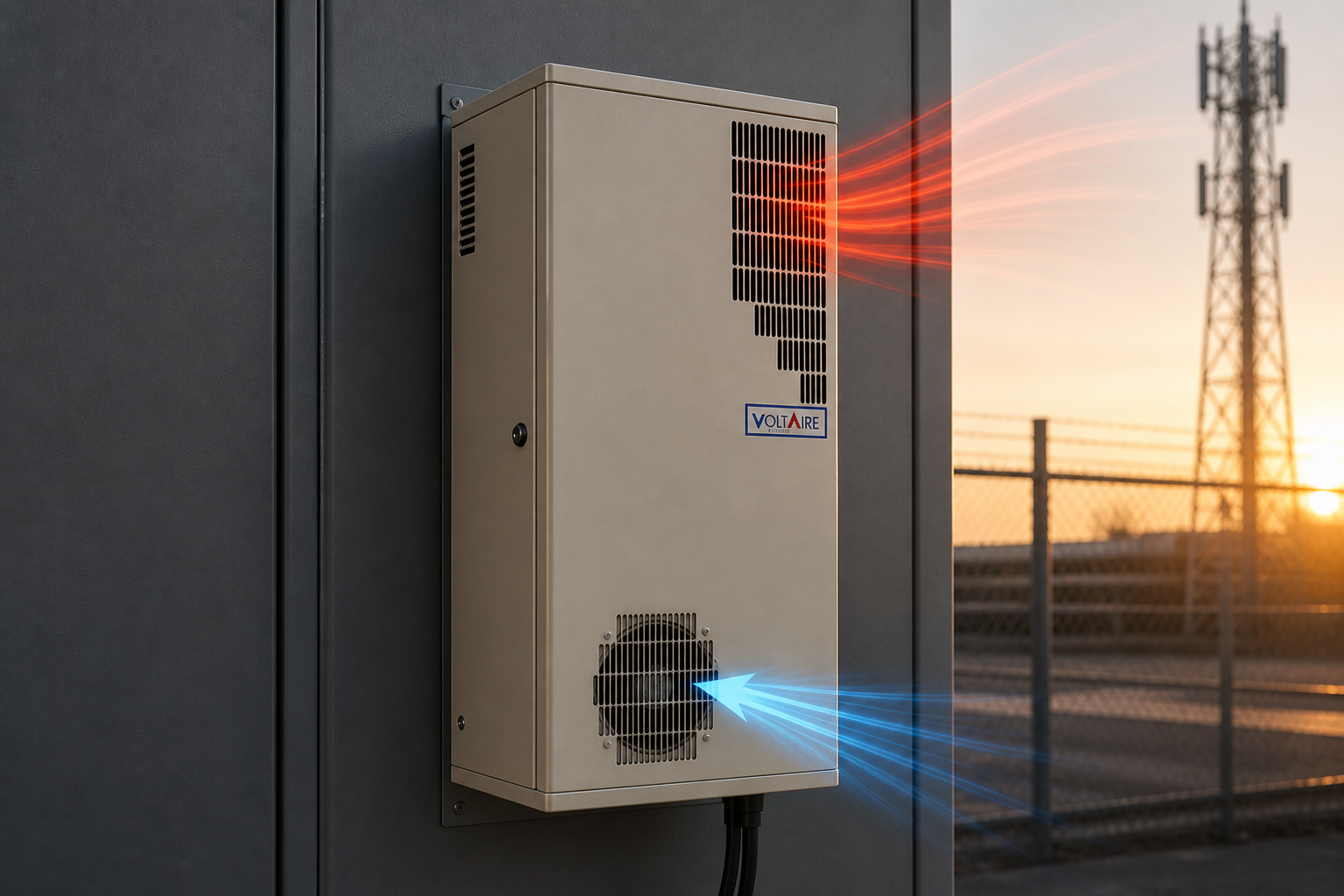
VoltAire Application Guide
Cooling for Outdoor Telecom Cabinets
GR-487 compliant, NEMA 4/4X rated cooling for cell sites, 5G base stations, and remote telco huts. Survives -40°F to 158°F, 720-hour salt fog, and the next 15 years of weather.
Quick Summary
Outdoor telecom cabinets — cell-site equipment huts, 5G small-cell enclosures, fiber distribution cabinets — need cooling that survives full outdoor exposure for 15+ years with no on-site technician. The right product depends on whether your enclosure ambient is below your equipment's max rating (use a heat exchanger) or above it (use an outdoor air conditioner). VoltAire offers both: HIX/HTC heat exchangers (passive, no refrigerant, sealed core, 18–90 W/°F) for ambient-cooled sites and AT-series outdoor air conditioners (NEMA 4/4X, 4,000–19,000 BTU) for hot-climate sites. All units are GR-487 compliant and Made-in-USA BABA-eligible for federal broadband programs (BEAD, RDOF, ReConnect).
Compliance Requirements
What this application requires
The standards that govern outdoor telecom cabinet cooling, why each one matters, and which VoltAire products meet them.
NEMA 4/4X
Sealed against wind-driven rain, blowing dust, ice, and corrosion. NEMA 4X adds stainless or coated finish for salt and chemical environments.
GR-487
Telcordia's outdoor electronic equipment standard. Mandates 720-hour salt fog testing per ASTM B117 and full thermal cycling. Required by most ILECs and broadband carriers.
UL 1995 / UL 484
UL 1995 for heat exchangers, UL 484 for room/enclosure air conditioners. Required for safety listing and most municipal permits.
BABA / Made in USA
Build America, Buy America. Required for federal broadband-funded projects (BEAD, RDOF, ReConnect, MMG). VoltAire is manufactured in Orlando, FL.
The Hard Parts
Why outdoor telecom cabinet cooling is a difficult cooling problem
The five operational challenges every spec needs to plan for — before you pick a unit.
Solar load on dark cabinets
An unshaded RAL 7035 light-gray cabinet in direct sun in Texas at 105°F ambient may experience an additional 200–500W of solar gain depending on size and orientation. Add this to your interior heat load before sizing.
No on-site technician
Most outdoor telecom sites are unstaffed. A failed cooling unit means a 4-hour drive and a hot-shutdown of the radio gear. Reliability and remote alarm contacts (low temp, high temp, fan fault) are non-negotiable.
Salt, dust, and pollution
Coastal sites face salt fog. Roadside cabinets face brake dust and exhaust. Compressor coils on commodity ACs corrode and clog within 3 years. Heat exchangers with epoxy-coated aluminum cores last decades.
Extreme temperature swing
A North Dakota site can see −40°F in January and 95°F in July. The cooling unit must operate across that entire range without compressor damage or oil migration. VoltAire AT-series and HIX/HTC units are rated −40°F to 158°F.
Lightning and power quality
Rural telecom sites have poor utility power. Surges, brownouts, and 48VDC-only sites are common. VoltAire offers 115VAC, 230VAC, and true 48VDC variants for direct connection to telecom plant power.
Decision Guide
Which Cooling Type Do You Need?
The first question for any outdoor cabinet cooling decision: is the outdoor ambient temperature usually lower than your equipment's max operating temp? If yes, a heat exchanger is the right answer 80% of the time — it's cheaper, sealed, and has no compressor to fail. If your max ambient is higher than your equipment can tolerate, you need active refrigeration (an outdoor AC).
Condition 1
Max ambient ≤ Equipment max temp − 18°F
Recommendation
Heat Exchanger (HIX or HTC)
A heat exchanger only needs ~18°F of difference between cabinet and ambient to dump heat efficiently. No compressor, no refrigerant, sealed against ingress. 50% lower operating cost than AC.
Condition 2
Max ambient > Equipment max temp
Recommendation
Outdoor Air Conditioner (AT-series)
When the air outside is hotter than your cabinet target, you need active refrigeration. AT-series units are NEMA 4/4X, R-410A or R-134a, and rated to 158°F ambient.
Condition 3
Site is 48VDC-only (no utility AC)
Recommendation
48VDC variant of either
Both HIX heat exchangers and select AT-series ACs are available in true 48VDC for direct telecom plant power. No inverter required.
Product Recommendations
VoltAire units for outdoor telecom cabinet cooling
Models commonly specified for this application. Heat exchangers (HX) and air conditioners (AC) — pick the type that matches your decision-tree answer above, then size for your specific heat load.
HIX018B — 18 W/°F Cross Flow
Compact heat exchanger for small fiber distribution and node cabinets. 48VDC, NEMA 4/4X, GR-487. Best for low-heat-load sites with adequate ambient differential.
View Heat ExchangersHTC020B — 20 W/°F Counter Flow
25% more efficient than equivalent cross-flow. Narrower profile fits tight cabinet spacing. Quieter fans. Best for mid-size cabinets with stricter noise or space constraints.
View Heat ExchangersAT04 — 4,000 BTU Outdoor AC
Compact NEMA 4/4X air conditioner for small outdoor cabinets where ambient runs hot. Available in 115V, 230V, and 48VDC.
Configure & PriceAT06 — 6,000 BTU Outdoor AC
Mid-capacity outdoor AC for typical 5G small-cell and macro-site cabinets in hot southern climates.
Configure & PriceAT12 — 12,000 BTU Outdoor AC
Larger capacity for fiber huts and equipment shelters with high heat loads or extreme southern desert ambients.
Configure & PriceReal Scenarios
Three real outdoor telecom cooling specs
Worked examples with the heat load, ambient, target temperature, and the resulting product recommendation. Use these as starting points for your own spec.
Scenario
Rural fiber distribution cabinet, Iowa
- Ambient
- Max 92°F summer, −22°F winter
- Heat Load
- 320W (passive electronics + small switch)
- Target
- 104°F max interior
Recommendation
HIX018B heat exchanger. 18 W/°F × (104−92) = 216W margin at peak. No refrigerant, no compressor failure risk on an unstaffed rural site. 48VDC direct from the cabinet plant power.
Scenario
5G small-cell cabinet, Phoenix AZ
- Ambient
- Max 118°F summer (with solar load)
- Heat Load
- 850W (radio + compute + battery)
- Target
- 104°F max interior
Recommendation
AT06 6,000 BTU outdoor AC. Heat exchanger won't work — ambient exceeds target. AT06 NEMA 4/4X handles 158°F operating range with margin.
Scenario
Cell-site equipment hut, North Dakota
- Ambient
- Max 95°F summer, −40°F winter
- Heat Load
- 2,400W (multiple radios + battery + DC plant)
- Target
- 95°F max interior
Recommendation
HTC050B heat exchanger (50 W/°F). Counter-flow efficiency is critical for high heat loads. AT-series available as backup if winter low-temp heater is also required.
Related Guides
Go deeper
Compliance references, sizing math, and product comparisons that pair with this application.
GR-487 Compliance Guide →
Complete reference: 720-hour salt fog, thermal cycling, EMC, and what NOT to confuse with NEBS.
BABA Compliance for Telecom Cooling →
What BABA requires, who needs it, and why VoltAire qualifies.
Heat Exchanger vs. Air Conditioner Decision Guide →
When to use which, with the cost and reliability trade-offs.
How to Size Enclosure Cooling →
Walk-through of the sizing math with worked examples for outdoor sites.
Frequently Asked Questions
Common questions about outdoor telecom cabinet cooling.
What is the difference between NEMA 4 and NEMA 4X for telecom cabinets?
Is GR-487 compliance required for all telecom cabinets?
Can I use a heat exchanger in Phoenix or other extreme-heat sites?
What about 48VDC sites with no utility power?
How long does an outdoor cooling unit typically last?
Are VoltAire outdoor units BABA compliant for federal broadband programs?
Other Applications
Different environment or vertical?
Ready to spec your build?
Designing an outdoor telecom cabinet build? Talk to a VoltAire engineer for cooling spec recommendations matched to your radio plan, climate zone, and compliance requirements.